

I bought the Sawyer Mini because a friend pulled one out of her hip pocket on a Three Sisters trip and filtered a liter of creek water while I was still unscrewing the cap on my old pump. That was four summers ago. I have carried a Sawyer on every trip since, and I have also left it at home on purpose twice, which probably tells you more about this filter than any spec sheet will. What follows is the version I would give a friend at the trailhead, not the version printed on the package.
The short version is this. The Sawyer Mini is a genuinely clever piece of engineering that weighs almost nothing and asks for no batteries, no replacement cartridges, and no maintenance beyond a small plastic syringe. It is also slower than you expect, fussier to clean on the trail than the ads suggest, and it ships with a pouch I stopped trusting inside a month. Whether that trade is worth it depends entirely on how you camp. I have camped enough in the Cascades to know the difference between a filter that works in a review and a filter that works at seven in the morning when your hands are cold and your husband is waiting.
The Quick Verdict
Light enough to forget and reliable enough to trust, but this is a sipping filter, not a filling filter. Plan on minutes rather than seconds, and bring a better bottle than the pouch in the box.
Amazon Check Today's Price →A Filter You Forget Is In Your Pack Until The Moment You Need It
Two ounces, no cartridges, no pumping, nothing to break. The Sawyer Mini has ridden in my hip pocket for four seasons and has never once been the reason a trip went wrong.
Amazon Check Today's Price on Amazon →How I've Used It
Most of my use is car camping out of a 2014 Subaru Outback at the Cascade Lakes, where the water question is easy and the filter is mostly insurance against a campground tap that tastes like a garden hose. Then there are the real tests, the two and three night trips into the Three Sisters Wilderness with my husband Dale, where every ounce gets argued about and where the lakes are cold, clear, and full of things I would rather not drink.
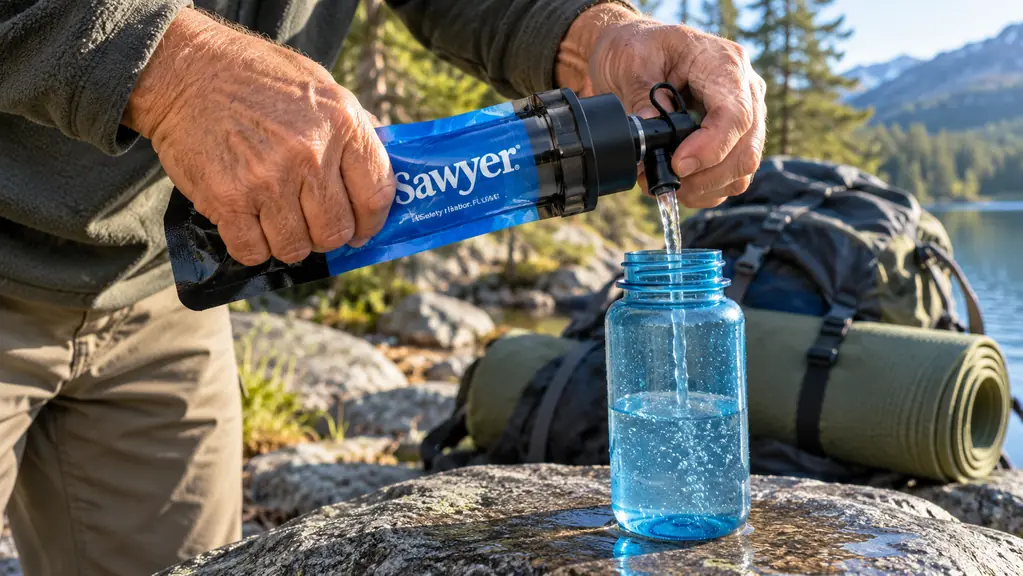
On those trips the Sawyer has done exactly what it claims. I fill the pouch from a lake, thread the filter on, and squeeze into my bottle or straight into my mouth. Dale and I share one filter, which works out to roughly four to six liters a day between us for drinking and cooking. It keeps up. It does not keep up quickly, and that is the part I want to be straight about.
I have used it on silty water off a side creek and on lake water with visible bits floating in it. Neither bothered it once I learned to scoop from the surface rather than stir up the bottom. I have never had a stomach problem on a trip where I used it. I have had one on a trip where I did not, which is the sort of lesson you only need to learn once before you become a person who always carries the filter.
One afternoon at a lake near the Pole Creek burn stands out. It was hot, we had come down a long dry stretch, and I stood in the shallows drinking through the straw for what felt like five minutes straight. Nothing about that moment felt like gear. That is the highest compliment I can pay a piece of equipment.
Two summers ago we came down off the Green Lakes trail on a Sunday with the thermometer reading ninety and a headwind the entire way. I finished the liter I was carrying inside the first hour, which is the sort of planning a retired science teacher should know better than to do. What saved the afternoon was a creek crossing about a mile above the trailhead. I stopped, scooped, threaded the filter on, and drank through the straw standing in the shade of a hemlock with my pack still on. Ten minutes of standing still and I walked the rest of the way down feeling like a person again. A pump would have turned that into a twenty minute production with a disassembled filter balanced on a rock, and I would have skipped it and been miserable.
The Part Nobody Warns You About: This Is a Sipping Filter
The Sawyer Mini is not a pump and it is not a gravity bag. It is a squeeze filter, which means the squeeze is doing all the work. Fill the sixteen ounce pouch, thread the filter on, and press. On a clean filter you get a steady stream. After a few days of use, especially on cloudy water, you get a thinner stream and noticeably more effort per mouthful.
That matters because the photographs suggest you fill a bottle in a moment. In practice, filling two one liter bottles for the evening takes me the better part of ten minutes, with rests. My left knee is fine standing in one spot, but my hands are not what they were at forty, and squeezing a pouch for ten minutes is a hand workout. Dale usually takes a turn partway through and does not complain, which is one of the reasons I keep him.
I timed it once, out of curiosity and because a retired science teacher cannot help herself. With a clean filter and clear lake water, a liter took about ninety seconds of steady squeezing. By the third day, on water carrying a fair amount of glacial flour, the same liter took close to three minutes and my forearm was filing a complaint. One backflush with the plunger brought it back to roughly two minutes. That is the honest performance curve, and I wish somebody had drawn it for me before I left the trailhead expecting ninety seconds forever.
The fix is not clever, it is just planning. I filter the evening and next morning water while dinner is being set up, when I am standing around anyway and the stove is already going. At home I do the same thing with coffee. You put the work where it overlaps with work you were already doing, and the slowness stops registering as slowness.
Cold Weather and the Mistake I Made in October
Shoulder season in the Three Sisters gets down near freezing at night, and that is where a wet hollow fiber filter needs some thought. Water left inside the membrane can freeze and expand, and a filter that has frozen solid is not something I trust afterward. I do not need a laboratory to tell me that. I now treat the Sawyer the way I treat my phone battery in cold weather. It comes into the sleeping bag with me, in a zip bag, next to my socks.
One October trip taught me the rest of it. We camped at a lake just under six thousand feet and the bottle sitting outside the tent had a skin of ice on it by six in the morning. I had left the filter screwed onto the pouch on the outside of my pack overnight, which is precisely the wrong thing to do. It did not freeze solid, or at least I do not believe it did, but I spent the next two days uncertain about the one piece of gear standing between me and a bad week. Uncertainty about a water filter is not a feeling I enjoy. Now it comes into the bag every night, no discussion, no exceptions, even when the forecast says forty degrees.
The other cold weather issue is simpler and more annoying. Cold hands, a stiff pouch, and a threaded connection add up to fumbling. I have learned to thread the filter onto the pouch before I take my gloves off, and to keep the whole assembly inside a zip bag in my pack so it is not sitting in a puddle of near freezing water when I finally want a drink.
What Genuinely Impresses Me
Two ounces. I have carried water bottles heavier than this filter. It fits in the palm of my hand, and on trips where I am counting grams because my back has opinions about thin pads and heavy packs, that matters more than any feature list. The rated capacity is 100,000 gallons, which for a weekend backpacker is effectively forever. I will never come close, and neither will you.
The weight claim is easy to check, so I checked it. My kitchen scale puts the filter alone at forty one grams, which matches the listing and is less than the spoon I stir my coffee with. The pouch, the straw, and the plunger together add a couple of ounces to the whole kit, and even so the kit is lighter than the empty pump I used to carry on the outside of my pack. On a three night trip that difference is a bag of trail mix I get to bring instead, and I have never once regretted the trade.
The connection options are the quiet genius of the thing. It threads onto a standard 28 mm disposable water bottle, it splices into a hydration pack line, and it comes with a drinking straw so you can drink straight from the source. That last option is why it lives in my hip pocket rather than buried in the pack. A filter you have to unpack is a filter you skip.
It also asks for nothing. No batteries, no chemicals, no waiting for a tablet to dissolve, no cartridges to buy and remember. When the flow slows down I backflush it with the plunger that comes in the box and it comes back most of the way. The entire maintenance kit is one small plastic syringe, which is more than I could say for the pump I used to haul around and dread.
Four seasons, two ounces, zero parts replaced. The Sawyer Mini has never been the reason a trip went wrong. It has only ever been the reason I did not have to carry water in.

Where It Falls Short
The pouch. The sixteen ounce pouch that comes in the box is the weakest part of the kit and I will say so plainly. Mine developed a seam leak within a month of steady use, and I have watched two friends have the same experience on the same kind of trip. The filter was fine both times. The bag was not. Since then I have used a disposable water bottle as my dirty water container and treated the pouch as a spare that lives in the repair kit.
The failure is not dramatic, which is part of why it catches people out. It starts as a cool damp spot along the seam, then becomes a slow drip running down your wrist while you squeeze, and then you are holding a bag of lake water that is quietly leaking into your boots. Mine went in the second week of regular use, on a flat easy morning when I was not paying attention. I patched it with a strip of duct tape and the patch held for exactly one trip before it started again. That is when I switched to a one liter disposable bottle as the dirty container. It threads on directly and it has not leaked once in three seasons.
Drinking through the straw is slower than the photographs imply, and it takes a moment to get the angle right without pinching the line. It is lovely at a lake and awkward while walking. Most of the time I squeeze into a bottle instead.
The plunger works, but backflushing on the trail is a small production. You need clean water, you need somewhere flat to stand, and you need to not lose the little cap, which I have done once and found again after ten minutes on my hands and knees. I do it at the end of the day now, never in the middle of a hike.
And the honest headline. This is not a filter for a group. Two people is the practical limit before the squeezing turns into a chore and someone starts making suggestions about who should have bought a different filter. If you are filtering for a family of four at a car camp, you want a gravity system and I would not argue with you for a second.
What I Liked
- Two ounces in the hand, close to nothing in the pack
- Threads onto standard 28 mm bottles, hydration packs, or the included straw
- No batteries, no cartridges, no chemicals, no waiting
- Rated for 100,000 gallons, which is more than a weekend camper will ever use
- Backflushes with the included plunger and recovers most of its flow
Where It Falls Short
- Slow. Filling a liter takes real time and real hand strength
- The included sixteen ounce pouch is the weak link in the kit
- Awkward for groups larger than two people
- Needs care in freezing weather so the membrane does not hold ice
- Drinking through the straw is slower and fussier than it looks
The Cleaning Routine I Actually Follow
When I get home from a trip, the Sawyer gets backflushed with clean water from the kitchen tap and left to air dry with the ends open on a dish towel. That is the whole routine. It takes two minutes and it is the reason my filter from four seasons ago still works. The only cleaning tool I use is the plunger that came in the box, and I have never bought a consumable for it.
The plunger itself is small, which makes it easy to lose and easy to leave on a rock beside a lake. Mine now lives in the same zip bag as the filter, permanently, which is the single best piece of gear organization I have ever managed. If you take one thing from this review, take that.
Who This Is For
This filter is for the person who carries their own water and does not want to think about it. Weekend backpackers, day hikers on long loops, car campers who want a backup that lives in the glovebox and weighs nothing. It is also for anyone whose back or hands have started negotiating with them, because the Sawyer Mini removes the pumping entirely. You squeeze, you rest, you squeeze again.
It suits two people sharing one filter, especially if you are the sort who fills bottles in the evening while dinner cooks. It suits shoulder season trips as long as you sleep with it. It suits anyone who likes gear with no moving parts, because this one has none, and it suits the camper who would rather spend the evening looking at the lake than standing at a pump.
Who Should Skip It
Skip it if you are filtering for a group, if you are base camping with a water jug and want to fill four liters at once, or if you have hand or wrist trouble that makes repeated squeezing genuinely painful. A gravity filter hanging from a tree is the better answer for that camper. I say that as someone who loves this little thing and has recommended it to a dozen people.
Skip it too if you are going somewhere the water is questionable in ways a hollow fiber membrane does not address. The listing covers bacteria and protozoa and microplastics. It does not claim viruses, and if that distinction matters where you are headed, you need a different tool. I would rather tell you that plainly at the trailhead than have you find out on a riverbank in another country.
Buy It For The Ounces. Keep It Because It Has Never Let You Down.
The pouch is mediocre and the squeeze is slow, and I still would not go back to a pump. Two ounces that have never failed me is a trade I will make every single season.
Amazon Check Today's Price on Amazon →