

The first Sawyer Mini I bought came home in a zipper bag so small I nearly threw it out with the receipt. That is not a complaint. A filter that weighs two ounces and vanishes into a hip belt pocket is exactly what a sixty-one-year-old with a stiff left knee wants to be carrying at four in the afternoon. But the size is also why people misjudge it. It looks like a stocking stuffer, so it gets bought in June, tossed in a pack, and never practiced with until somebody is thirsty and impatient at a creek.
I have used this one for four seasons now, out of the back of our 2014 Subaru Outback at Cascade Lakes campgrounds and on two- and three-night loops in the Three Sisters Wilderness with my husband, Dale. It has filled bottles from snowmelt, from lake edges carrying a little too much algae, and once from a puddle I would rather not describe. Here is what four seasons taught me, including the parts that get on my nerves.
The Quick Verdict
Light enough to forget you packed it and rated for 100,000 gallons, with one honest catch: the squeeze is slow and the soft pouch wants two hands and some patience.
Amazon Check Today's Price →Two ounces, 100,000 gallons, and nothing to charge
The Sawyer Mini weighs 41 grams, runs on your hands, and carries a hollow fiber membrane rated for 100,000 gallons. That is the whole case for it. Practice with the pouch once at the kitchen sink and the trail version becomes second nature.
Amazon Check Today's Price on Amazon →How I've Used It
We keep two now. One lives in the car camping bin with the stove and the coffee pot, and one lives in my backpacking ditty bag so I cannot leave it on the kitchen counter. The car camping unit gets the most hours, because it is the one I hand to Dale when we are filtering a couple of liters for dinner at the picnic table. He is faster at it than I am. I am the one who reads the instructions first, so I get to be slower and more correct.
On backpacking trips it earns its place because of what it does not cost me. My base weight sits where it sits and I am not willing to add a pump filter and the arm workout that comes with one. Two ounces in a pocket is a fair trade. On our last three-night loop out of a Three Sisters trailhead, the filter rode in the top lid the whole way and I forgot it existed until lunch on day two, which is exactly the relationship I want with a water filter.
The trip that taught me the most was a two-night loop last September, the weekend before the equinox, when the forecast turned colder than anyone had planned. We came off the trail at a lake outlet around two in the afternoon with maybe half a liter between us. I filled the 16-ounce pouch four times in a row and it took me close to twelve minutes to get a liter and a half into our bottles, because the filter had gone a whole season without a backflush and I could feel it in my forearms. That was my fault, not the filter's. It is also the exact situation where a slow filter stops being an abstraction and starts being a reason to fill bottles earlier in the day.
I have also used it in the dumb ways. I have filled the pouch from a lake edge while kneeling in mud, which is a two-hand job and hard on the knee. I have squeezed too hard and gotten a mouthful of air. I have dropped the whole assembly in a creek and fished it out by the straw. It survived all of that, which says more about the thing than any of my careful testing did.
What the Numbers Actually Mean
The listing says 0.1 micron absolute, hollow fiber membrane, and that is the number that matters. Absolute means the pores are at or below that size rather than averaging out to it. At 0.1 microns, bacteria and protozoa are physically too large to pass through. Sawyer rates the membrane against 99.999999% of bacteria including Salmonella, Cholera and E. coli, and 99.9999% of protozoa including Giardia and Cryptosporidium. It also removes microplastics. If you have ever spent a bad week after drinking from a questionable source, those percentages stop being abstract.
I taught middle school science for twenty-nine years, so let me say the honest thing about all those nines. No backcountry filter makes water sterile, and this one is no exception. A hollow fiber membrane does not remove viruses, which is why it is the wrong tool for travel where viruses in the water supply are a genuine risk. For Cascade Lakes and the Three Sisters, viruses are not the worry. Giardia, sediment and whatever the geese left behind are the worry, and the membrane handles all three.
Capacity is listed at 100,000 gallons, which I dismissed as a marketing number until I did the arithmetic. A weekend trip is maybe six liters. A long trip, maybe fifteen. Even if I filtered five liters a day for the rest of my hiking life, I would not come close to the rated life of the membrane. The practical limit is not the specification, it is whether I backflush the filter and store it dry so it stays usable.
Here is the arithmetic, done on the back of a wilderness permit envelope at the kitchen table. A two-night trip runs me about six liters. A three-night trip, maybe nine. I get out eighteen or twenty weekends a year between car camping and backpacking. Call it a hundred and sixty liters in a season, which is a little over forty gallons. At that pace the membrane would outlast my knee, and my knee has already outlasted three pairs of boots. That is the useful way to read a 100,000 gallon rating. It is not a promise about your lifetime. It is a way of saying the filter will not be the part that fails on you, provided you keep it clean and keep it from freezing.
0.1 micron absolute, rated against 99.9999% of protozoa, 41 grams, and it fits in the palm of my hand. It asks for a backflush and a little patience, and gives back water I trust.
The Squeeze, the Straw, and the Pouch
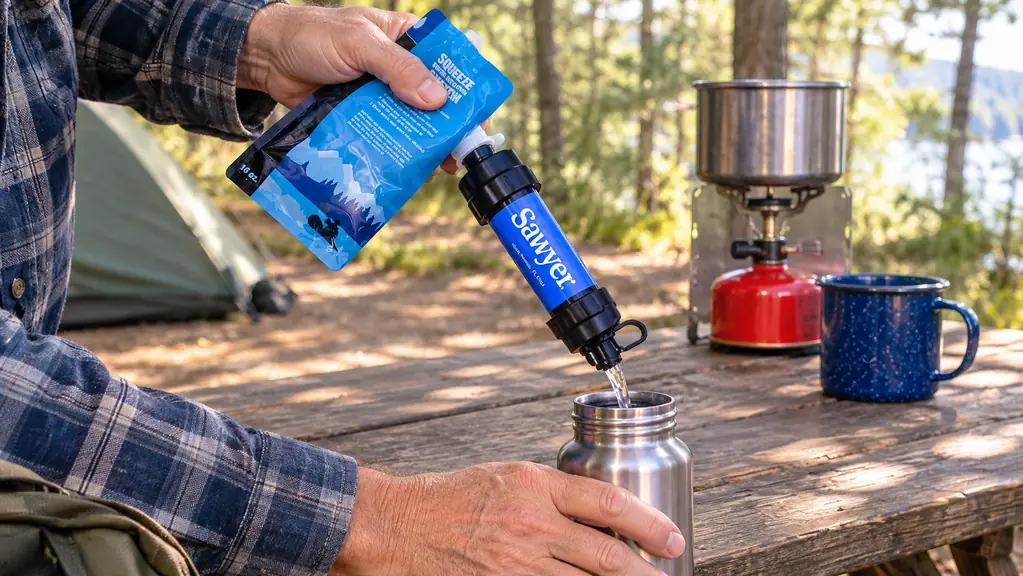
There are three ways to run it and I have tried all of them. The first is the squeeze: fill the included 16-ounce pouch, screw the filter onto the mouth of it, and press. The second is the straw, drinking straight through the filter with it dunked in a bottle or a lake. The third is inline, threaded into a hydration pack line. Sawyer also lists standard 28mm disposable bottles, which means the filter screws onto a great many ordinary store bottles without any adapter at all.
The squeeze is what I use ninety percent of the time. It works, and it is slow. You fill the pouch, screw on the filter, and press. A liter takes a few minutes of steady work, and the pace depends on how much you have been drinking through it lately and how faithfully you backflush. My first trip with a new filter made me impatient. By the third trip I had stopped noticing, because I had learned to fill bottles before I was thirsty instead of after.
I timed it once, out of plain curiosity, at the picnic table at a Cascade Lakes campground with a mug of coffee going cold beside me. A full 16-ounce pouch squeezed steadily into a wide-mouth bottle ran right about two and a half minutes on a filter I had backflushed that morning. Skipped the backflush and the same pouch took closer to four. That pair of numbers tells you more about what your evening looks like than anything on the listing does. I have also screwed the filter straight onto a plain 28mm store bottle, which works exactly as advertised and is handy when the pouch is gritty and I just want to fill from a campground spigot.
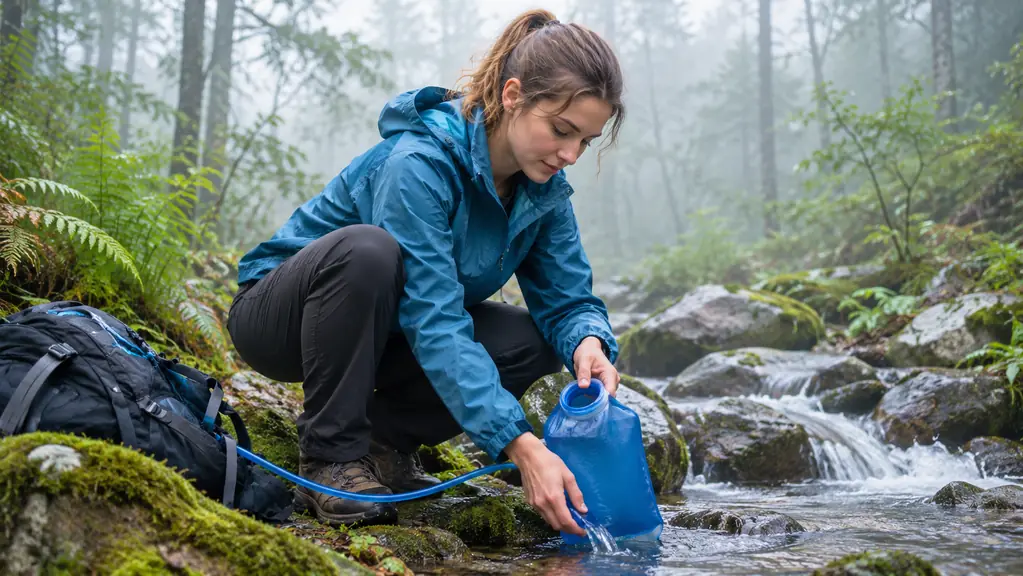
The straw is my least favorite, mostly because it means kneeling at the water with my face near the surface and my knee files a formal complaint. It is the right mode for a quick drink on a hot climb when you do not want to unpack anything. The pouch is the part people underestimate. A soft 16-ounce pouch full of water is floppy, and filling it from a shallow creek takes both hands and a certain amount of dignity. That is not a defect. It is what a two-ounce filter costs you in convenience.
Where It Slows Down
Everything I do not love about the Sawyer Mini traces back to one design decision: the water moves because you push it. That is why the unit weighs two ounces and has nothing to break. It is also why a cold morning makes it feel like a chore. After a few seasons the flow slows noticeably if you skip the backflush, and the included cleaning plunger is the fix. Backflush it with clean water after every trip and it comes back close to how it started.
The morning I remember was in early June at a lake around 6,400 feet, thirty-eight degrees according to the little thermometer clipped to my pack strap, and the filter had spent the night in the top lid. It ran at maybe half its usual pace until I had carried it in a jacket pocket for ten minutes. Nothing was wrong with it. Cold water is thicker, the membrane is tight, and my hands were stiff enough that squeezing was comedy. If you filter before coffee in shoulder season, budget the time and put your gloves on first.
The plunger is small and easy to lose, which matters because the whole maintenance routine depends on it. Mine lives in a little stuff sack with the filter now, after the second one went missing in the bottom of a bin. Sawyer sells replacements, and I have bought one. Backflushing takes about a minute. Doing it at the kitchen tap before you put the filter away is a habit worth building in your first month, while the novelty still makes you diligent.
Freezing is the other thing to respect. A wet hollow fiber membrane left in a cold vehicle overnight can be damaged when ice forms in the fibers, and a damaged filter can still look fine and still pass water. Shoulder season in the Cascades drops near freezing at night more often than people expect. I sleep with the filter in my quilt footbox when the forecast is cold, which sounds fussy right up until you have to replace one.
Cleaning, Storage, and What I Would Change
Storage is easy. Backflush, shake it out, let it air dry before it goes back in the bin. A filter stored wet and sealed for months is a filter that smells like a pond the next time you want to use it. I dry mine on a paper towel on the counter for a day, which my husband finds ridiculous and which has kept both units working. None of the maintenance is hard. It is a routine, and routines are the first thing to go when a trip gets busy.
My wish list is short and petty. I want the pouch to fill without a wrestling match. I want the plunger to clip to the filter so the two cannot be separated in a bin. Neither of those is a reason to skip the product. This is a filter that has done everything I asked of it, in snowmelt and in water I would not have let a classroom drink, and it has never once made me sick.
What I Liked
- 41 grams and small enough to live in a hip belt pocket
- 0.1 micron absolute hollow fiber membrane rated for 100,000 gallons
- Screws onto the included pouch, hydration pack lines, and many standard 28mm bottles
- No batteries, no pumping, nothing to charge or forget
- Backflushes clean in about a minute with the included plunger
Where It Falls Short
- The squeeze is slow, especially as the membrane loads up
- The soft 16-ounce pouch takes two hands and some patience to fill
- The cleaning plunger is easy to lose
- A wet filter left to freeze can be ruined
- Drinking through the straw means kneeling at the water
Who This Is For
This is for the backpacker or car camper who wants one small thing to handle drinking water without adding a pound or a chore list. If you hike two or three nights at a stretch, filter for one or two people, and you are willing to spend three minutes filling bottles before you are desperate, the Sawyer Mini is the version of this I would put in your hand. It also suits anyone who wants a filter that lives permanently in a vehicle or a daypack without being noticed. At 41 grams there is no good argument for leaving it home.
Who Should Skip It
Skip it if you are filtering for four or more people at dinner, because a squeeze filter becomes a bottleneck and everyone stands around watching you work. Skip it if hand or shoulder trouble makes repeated gripping painful, since the whole system runs on your grip. Skip it if you are traveling somewhere that viruses in water are a real concern, because a hollow fiber membrane does not remove them and you want a purifier instead. And skip it if you would rather turn a knob and watch a bottle fill itself. That is a different product, and it weighs more.
The filter that lives in the pack and never asks for anything
Two ounces, a 0.1 micron hollow fiber membrane, and a 100,000 gallon rating. Backflush it, dry it, and it goes back in the lid for next season. Check the current price before your next trip and give the pouch one practice run at the kitchen sink first.
Amazon Check Today's Price on Amazon →