

My back has opinions. It started having them after a ski injury took out my left knee and rearranged how I walk, and it has not gotten any quieter in the years since. So when the Gear Doctors Oxylus arrived, I did what any reasonable woman in her sixties does with a new sleeping pad. I unrolled it on the living room floor, lay down on it in my hiking clothes, and stayed there for twenty minutes waiting to be told whether it was any good. My back said yes, and it said it before I had finished settling my shoulders.
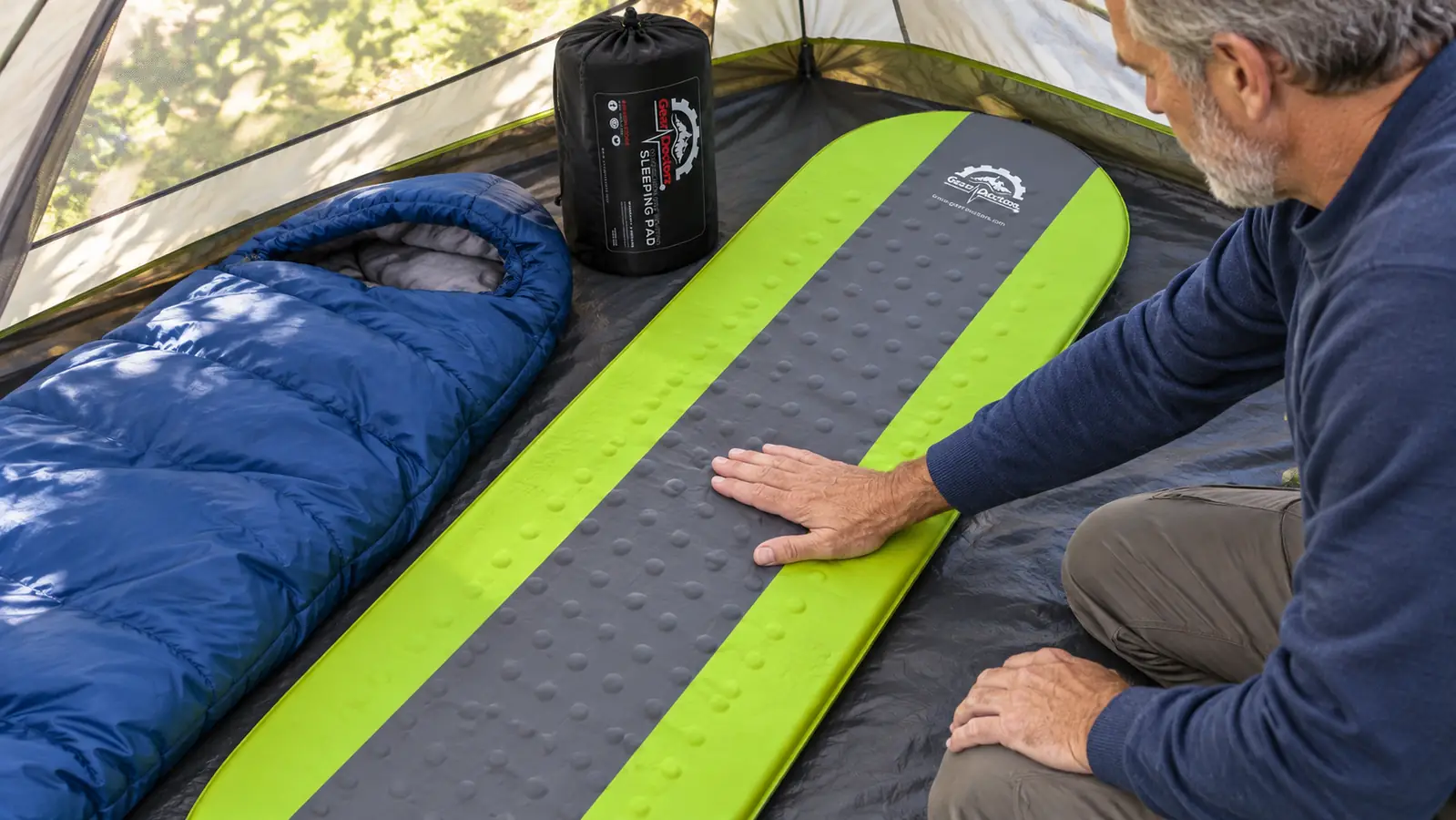
Here is the short version before the long one. The Oxylus is a self-inflating pad, which means foam inside an air chamber does most of the work and you only top it off. Gear Doctors lists it at a 4.3 R-value, 1.5 inches of thickness, 72 inches long by 22 inches wide in a rectangular cut, and 2.2 pounds. I slept on it for a full shoulder season, at Cascade Lakes campgrounds out of the back of our 2014 Subaru Outback and on two three-night trips into the Three Sisters Wilderness, with frost on the windshield most mornings. My back stopped waking me at two in the morning. That is more than the thin foam pad it replaced ever managed in fifteen years of trying.
The Quick Verdict
Warm enough for a hard frost, thick enough for a back that complains, and light enough that I will carry it uphill. It is bulky in a pack and it is not a three-inch mattress. Buy it for the sleeping.
Amazon Check Today's Price →The pad that ended my two-in-the-morning wake-ups
Self-inflating foam core, 4.3 R-value, 1.5 inches thick, 2.2 pounds. See the current price and the size options on Amazon.
Amazon Check Today's Price on Amazon →How I've Used It
Dale and I camp the way a lot of retired couples do. Long weekends at a Cascade Lakes campground where the car sits twenty feet away, and once or twice a season a real trip into the Three Sisters with everything on our backs. Shoulder season is our favorite time because the crowds thin out, and shoulder season in central Oregon means the temperature drops to freezing or just under it by three in the morning. That is the condition I test a pad in, because that is the condition that decides whether I sleep or lie there cataloguing the cold in my hip.
I slept on this pad for twenty-two nights between late April and the end of October. Nine were car camping, thirteen were on the ground away from the car. The coldest was twenty-nine degrees at a lake outside Sisters, and I was warm enough in long underwear and a fleece that I never put on the puffy jacket I had staged next to my head. I am not a warm sleeper. I am a woman in her sixties with poor circulation who used to bring a second pad purely for insulation, and who spent a decade telling herself that being cold at night was just part of it.
The pad has been rained on, slept on by a friend's teenager for one night when we had a spare, and folded and unfolded enough times that a lesser pad would be showing a seam by now. The surface shrugs water off, which matters when you crawl in with a damp jacket. Nothing has delaminated, nothing has bubbled, and the valve still seats the way it did in April. That is a short list of things that did not go wrong, and after twenty-two nights it is the list I care about most.
What a 4.3 R-Value Actually Does for You
R-value measures how well something resists heat leaving your body. The number on the label matters less than whether the ground pulls the warmth out of your hip. An uninsulated air pad sits around one, and at thirty degrees it will make you colder than lying on bare dirt, because the air inside it moves and carries heat away. A 4.3 rating puts this pad in three-season territory. Comfortable to below freezing, not built for snow.
What I noticed is that the cold stopped coming up through my hip. On the foam pad I used before, I would wake around two or three and find the side I was lying on had gone numb, and I would have to turn over and lose ten minutes getting back to sleep. That stopped happening here. I turned over because I wanted to, not because the ground had decided for me. Gear Doctors rates this one at 4.3, and my hip agrees with the label, which is not something I can say often.
The warmth comes from the foam core, not from trapped air alone, so it does not depend on how hard you inflate it. That is the practical difference between this and an air-only pad. If yours goes soft in the night because the temperature dropped and the air contracted, you are still on foam. On an air pad, that same night means you are on the ground. I have had both nights and I know which one I would rather have.
Twenty-two nights, hard frost on most of them, and the pad never once woke me up. The ground did not get through it.
Inflation, Deflation, and the Five-Minute Claim
The Gear Doctors listing says from pack to sleep ready in under five minutes, and my experience is that this is honest for the inflating half. You unroll it, open the valve, and walk away. The foam expands and pulls air in on its own while you are laying out your bag and finding the headlamp. I timed it twice: four minutes to get most of the way and six to where I would call it finished, with maybe thirty seconds of breath added at the end to take it from soft to medium.
That top-off is worth mentioning because self-inflating pads never quite do the last ten percent by themselves. Two or three full breaths through the valve and it firms up. The pad is listed as medium firmness and that felt right to me. Firm enough that my hip did not bottom out, soft enough that my shoulder did not complain when I rolled onto my side. If you have ever spent a night on a pad that was either a rock or a hammock with no middle setting, the word medium earns its keep here.
Deflating is the part nobody enjoys. Open the valve, start rolling from the head end, and the air leaves as you go. It takes two passes to get it flat enough to fold into the carry bag. The bag is included, along with a repair patch I have not needed. If you are packing up in the rain, give yourself an extra couple of minutes, because the foam wants to re-expand while you are rolling it and you will lose that fight if you rush. I lost it twice before I learned to kneel on the pad as I rolled.
How 1.5 Inches Treats a Back With Complaints
Three inches of car-camping mattress this is not. The Oxylus is 1.5 inches thick, and on a hard floor that is a pad, not a bed. On forest duff, or a tent floor with a footprint under it, 1.5 inches of medium foam turns out to be enough, and I say that as someone whose back has vetoed thinner pads in the past, loudly and at length.
The reason it works for me is that foam pushes back along its whole length instead of in isolated spots. An air pad holds you up in a hull shape and your hips and shoulders end up in a pocket. I slept on my side, which is how I sleep at home, and I did not wake up with a numb arm or a bruised hip. My left knee, which does not like being bent for hours, was fine as long as I put a stuff sack under it. Small trick, big difference.
The honest limit: if you are a side sleeper with wide hips and you sit close to the 250 pound capacity, 1.5 inches will compress under you and you will feel the ground through it. At my weight it never bottomed out. My friend's teenager, who is heavier than I am, slept on it one night and said it was fine but he would not want a week of it. That is a fair summary of the thickness, and I would rather tell you that now than have you find out on night two of a three-night trip.

The Weight and Bulk Question
Two point two pounds. That is the number that decides whether a pad goes in the pack or stays in the car, and for me it lands on the right side of the line. My old closed-cell foam pad was lighter but slept like a sheet of plywood. My air pad was lighter still but it was cold. This is the first pad I have owned where I did not have to choose between sleeping and carrying, and after a certain age that stops being a luxury and starts being the whole point.
It is not a featherweight, and it does not pack down to the size of a water bottle. It rolls into a bundle that takes a real share of a 50 liter pack, roughly a sleeping bag's worth of room. On the Three Sisters trip I strapped it outside the pack on the second day when I wanted the interior for food, and that worked fine. If you are counting grams for a long thru-hike, this is the wrong pad and you already know it. If your trips are two or three nights and your knees are the limiting factor, the extra pound is money well spent.
The 250 pound capacity, the 72 by 22 inch rectangle and the 1.5 inches all point at the same camper: an adult who wants a predictable night, not a mountaineer counting ounces. At 22 inches wide it is wide enough that my arms did not hang off the edges, which was a running problem on the 20 inch pad I had before. Dale, who is broader than I am, tried it and did not slide off either. He still prefers his own pad, but he stopped making jokes about mine.
Small Things I Noticed After the Tenth Night
The rectangular shape matters more than I expected. A tapered pad saves weight by narrowing at the feet, and every tapered pad I have owned has ended with my feet sliding off the edge by morning. This one is the same width at the bottom as at the top. My feet stayed on it. That sounds like a small thing until you have spent a cold night half off your pad with your toes pressed against the tent wall.
The surface is water resistant, and I tested that by accident when a water bottle leaked inside the tent. The water beaded and I wiped it off with a bandana. It is not a waterproof mattress and I would not sleep on a wet tent floor in it, but a spilled bottle is not a crisis. The carry bag has a drawstring and enough room that I am not wrestling it at six in the morning, which is more than I can say for the bag on my last pad. The repair patch lives in the bag and has stayed there.
The valve is the one thing I would change. It works and it has not leaked, but it is a valve you open and close by hand, and on a cold morning with stiff fingers I fumbled it twice. A valve that lets air out without letting it back in while you roll would make packing up faster. That is a small complaint about a pad I otherwise stopped thinking about, and stopping thinking about a piece of sleeping equipment is the highest compliment I can give one.
What I Liked
- Warm well below freezing: the 4.3 R-value and foam core kept the cold out on nights in the high twenties
- Medium foam at 1.5 inches supported my back and hip for 22 nights without bottoming out
- 2.2 pounds is light enough that I carried it on three-night trips without resenting it
- The full 72 by 22 inch rectangle keeps feet and arms on the pad
- Water resistant surface handled a spilled water bottle without soaking through
- Carry bag and repair patch included, and the bag is actually sized for the pad
Where It Falls Short
- Rolls up bulky for a backpack, roughly a sleeping bag's worth of room
- Self-inflation stops about ninety percent of the way, so you still add breaths
- 1.5 inches is not enough for a heavy side sleeper near the 250 pound limit
- The hand-turned valve is fiddly with cold fingers
- Not a winter pad, and not meant for snow
Who This Is For
This pad suits a car camper who also takes the occasional two or three night backpacking trip and wants one pad for both. It suits anyone who sleeps cold and is tired of waking up because the ground is winning. It suits side sleepers under about 200 pounds who want foam support without hauling a full car-camping mattress. It suits people whose backs have started negotiating with them. And it suits anyone who has decided that 2.2 pounds and a bulky roll are a fair trade for a night they do not spend awake.
If the question in your head is whether you can still sleep on the ground at all, the Gear Doctors Oxylus is the pad that answered yes for me. It is the same reason I keep pointing people toward self-inflating pads when their back starts complaining, and toward an honest look at how this design differs from a plain foam pad before they spend anything at all.
Who Should Skip It
Skip it if you are counting grams. A dedicated air pad will cut most of a pound and pack smaller, and if your trips are long and your knees are fine, that trade is worth it. Skip it if you are a heavy side sleeper close to the 250 pound limit, because 1.5 inches will compress and you will feel the ground. Skip it if you want a mattress rather than a pad, the three inch kind you inflate in a tent you drove to. Skip it if you camp in snow, because 4.3 is a three-season number and no amount of wishing changes that. None of that makes it a bad pad. It makes it the wrong pad for those jobs and the right one for mine.
One pad for the car and the trail, so long as you are not counting grams
4.3 R-value, 1.5 inches thick, 72 by 22 inches, 2.2 pounds, and a carry bag that fits. Check today's price on Amazon before your next shoulder-season trip.
Amazon Check Today's Price on Amazon →