

For about twenty years I carried more water than I needed. Two liters out, two liters back, because that is what the old books said and because treating water seemed like a hassle I could sidestep by simply hauling it. My back filed complaints the whole time.
Then a friend handed me a Sawyer filter the size of a small plum and told me to leave the extra liter at home. I did. My pack dropped a couple of pounds, my left knee stopped announcing itself on the descents, and I have carried a filter on every trip since. That first trip was a two-night loop out of the Green Lakes trailhead in late August, and I remember standing at the outlet of the lake filling the pouch and thinking that I had been doing this the hard way for two decades for no reason at all. Here are ten reasons I think one belongs in your pack too, in roughly the order they occurred to me on the trail.
The filter that ended my two-liter habit
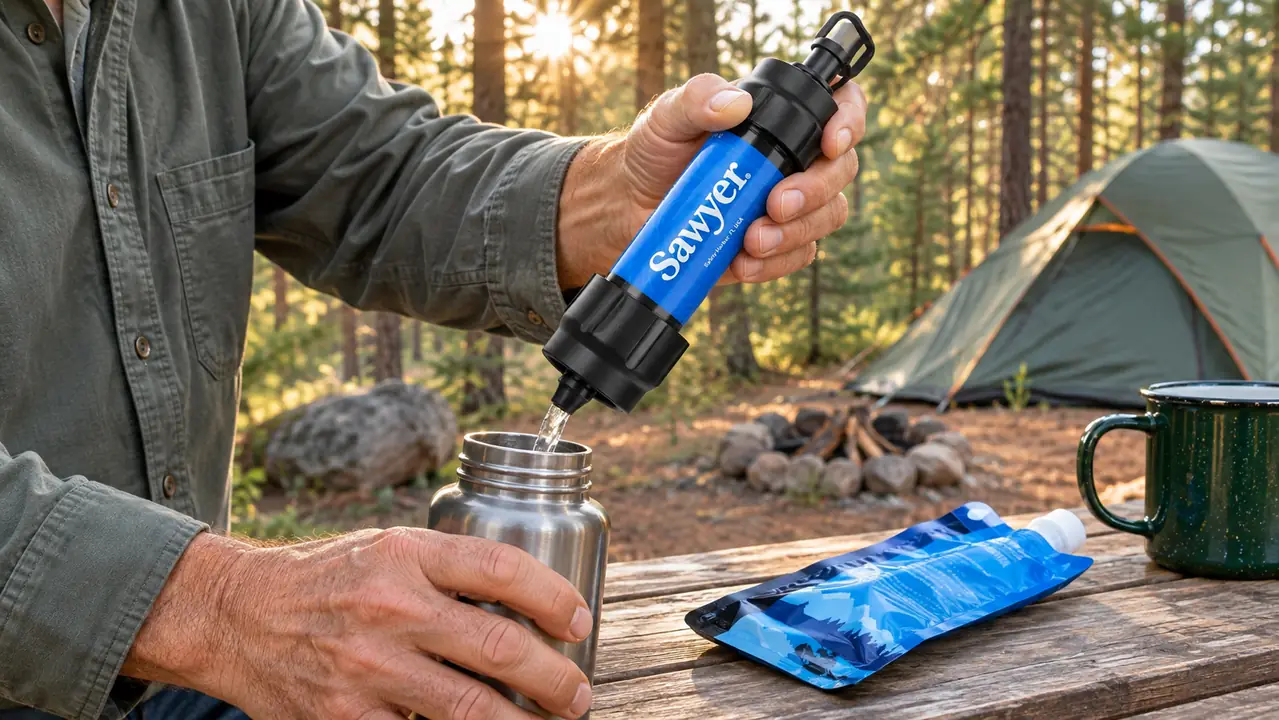
A Sawyer Mini weighs 2 ounces, fits in a hip belt pocket, and treats up to 100,000 gallons. It comes with a 16-ounce pouch, a drinking straw, and a cleaning plunger.
Amazon Check Today's Price on Amazon →It takes two pounds off your back before you even leave the trailhead
A liter of water weighs about 2.2 pounds. On a three-day trip, carrying your own supply means carrying it up every climb. With a filter, I leave the trailhead with one bottle and refill at the lake or the creek, which is exactly where I was going to stop anyway. My back noticed the difference by the second mile. So did my knee. The climb to the first lake on my usual loop gains about a thousand feet over three miles, and two liters for that stretch used to mean stopping twice to catch my breath and once to shift the load off my shoulders. With one bottle in the side pocket I went up in a single push last July, and Dale asked me what had gotten into me. Nothing got into me. Something came out of my pack.
It weighs less than the sandwich you will eat on day one
The Sawyer Mini is 41 grams, which is about an ounce and a half. It is genuinely palm-sized. I keep it in the same hip belt pocket as my lip balm and I forget it is there until I need it. There is no pump handle to break and no bottle of tablets rattling around at the bottom of the pack.
Creek water in the Cascades is not as clean as it looks
I taught middle school science for thirty-one years. I have looked at pond water under a microscope with a room full of twelve-year-olds, and I have never gotten over it. Clear, cold, fast-moving water can still carry Giardia and Cryptosporidium. The Mini removes 99.9999% of protozoa and 99.999999% of bacteria, and it also takes out microplastics. That is not fear talking. That is the handout I used to give out. The sample I used every year came from a stock tank on a farm outside town, and under the scope it was a moving city. Parents would ask why we did not just drink straight from the creek, and I would put the slide under the light and let the question answer itself. The 0.1 micron absolute membrane is smaller than the cysts those organisms ride in, which is the whole trick.
You stop rationing, and rationing is how people get dehydrated
When water is heavy, you sip carefully. You save the last half liter for the climb. You come home with a headache and a cranky husband. When refilling is a five-minute job, you drink like a person should, and you arrive at camp feeling human. Dale and I both noticed this on a hot September trip into the Three Sisters. We came over the pass on the second afternoon with the temperature near eighty and my bottle empty since lunch. In the old days that would have meant a headache by the time we reached the car. Instead we stopped at the creek below the switchbacks, filled the pouch, and drank until we were not thirsty anymore, then filled it again.
It screws onto a standard disposable bottle
This is the part that sold me. The filter attaches to the included 16-ounce pouch, to standard 28 mm disposable water bottles, and to most hydration pack bladders. I do not have to buy a proprietary bottle system or remember a special adapter. Whatever bottle the gas station in Sisters is selling, it will work.
The straw means you can drink straight from the source
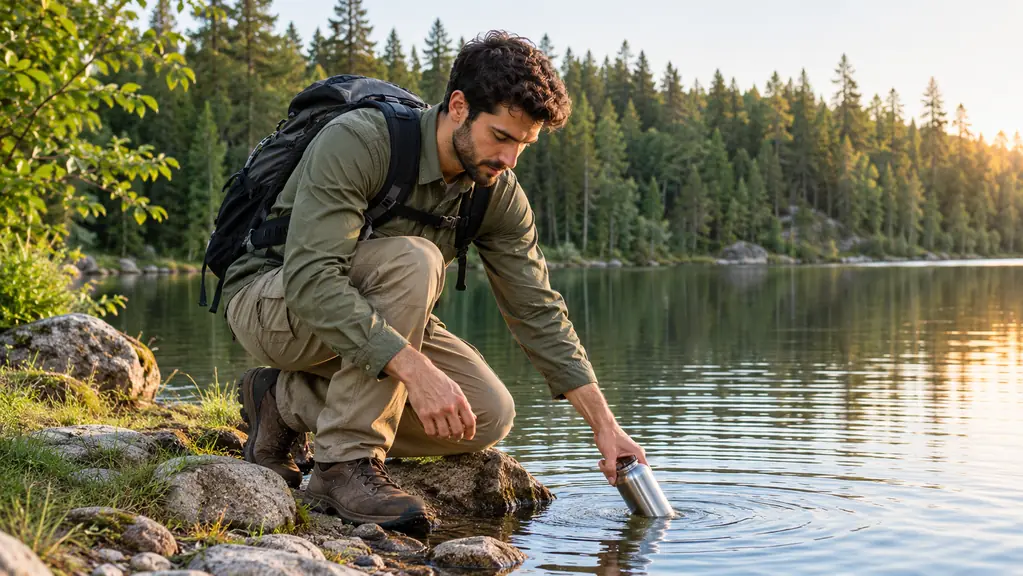
The kit includes a drinking straw, so you can dip the filter into a lake and drink without filling anything first. It feels strange the first time. It also means a rest stop at a lake does not have to turn into a bottling operation with a pack off and a filter out.
A plunger instead of a filter that clogs and quits
The hollow fiber membrane will slow down as it loads up with sediment, and that is normal. What is not normal is throwing the filter away. The kit includes a cleaning plunger, and backflushing with it takes about a minute. I do this every couple of trips and the flow comes right back. The first time I backflushed I was surprised how much grit came out. Fine gray sediment, the kind that settles in a slow eddy. Skip that step and the flow drops off, and you will convince yourself the filter is finished when it is not.
One filter covers a hundred thousand gallons of trips I will never take
The rated capacity is 100,000 gallons. I do not know what I would do with that much water, but I know I will never replace this filter. For a car camper who takes a few short backpacking trips a season, it is the last water filter I will buy. The cost per trip rounds to nothing.
It lives in the car when I am not backpacking
We car camp out of a 2014 Subaru Outback at Cascade Lakes campgrounds for much of the summer. The filter stays in the glove box. If the campground faucet is out or we end up at a primitive site, we are covered. It is the cheapest travel insurance in the vehicle. Last June the spigot on our loop was shut off for a repair and did not come back on until the next morning. We walked down to the lake, filled the pouch twice, and made coffee on the camp stove as usual. Nobody had to drive into town for a gallon jug.
It turns a stuck plan into an ordinary one
A trip I remember well: a late-season snowmelt had blown out the road and we were going to be three miles from the nearest potable water. In past years that would have meant turning around. Instead we filled up at a side creek and kept going. A filter is not a gadget. It is permission to keep walking.
What I'd Skip
I would skip the pump-style filters for short trips. They work well and I have used them for years, but they add a good half pound to a pound to your pack and the handles are the part that fails. I would also skip a filter with a proprietary bottle, because then you are married to it, and skipping a proprietary bottle is most of why the Sawyer appealed to me in the first place. And if you are strictly a car camper who never walks more than ten minutes from the vehicle, you may not need this at all. Carry water in a jug. That is a fine choice. The Sawyer is for the trips where the water is where you are going, not where you parked.
The Mini removes 99.9999% of protozoa and 99.999999% of bacteria, and it also takes out microplastics. That is not fear talking. That is the handout I used to give out.
Two ounces of pack weight that buys you every lake on the map
Sawyer Mini: 0.1 micron absolute hollow fiber membrane, rated to 100,000 gallons, 41 grams. Attaches to the included 16-ounce pouch, 28 mm disposable bottles, or a hydration pack. Backflush plunger included.
Amazon Check Today's Price on Amazon →