

If you are standing in a gear shop holding both of these in your hands, they look like the same idea twice. A short cylinder, a couple of ounces, a promise that you can drink from a creek. The difference is not in the shape. It is in what you have to do with your body to get a mouthful of water.
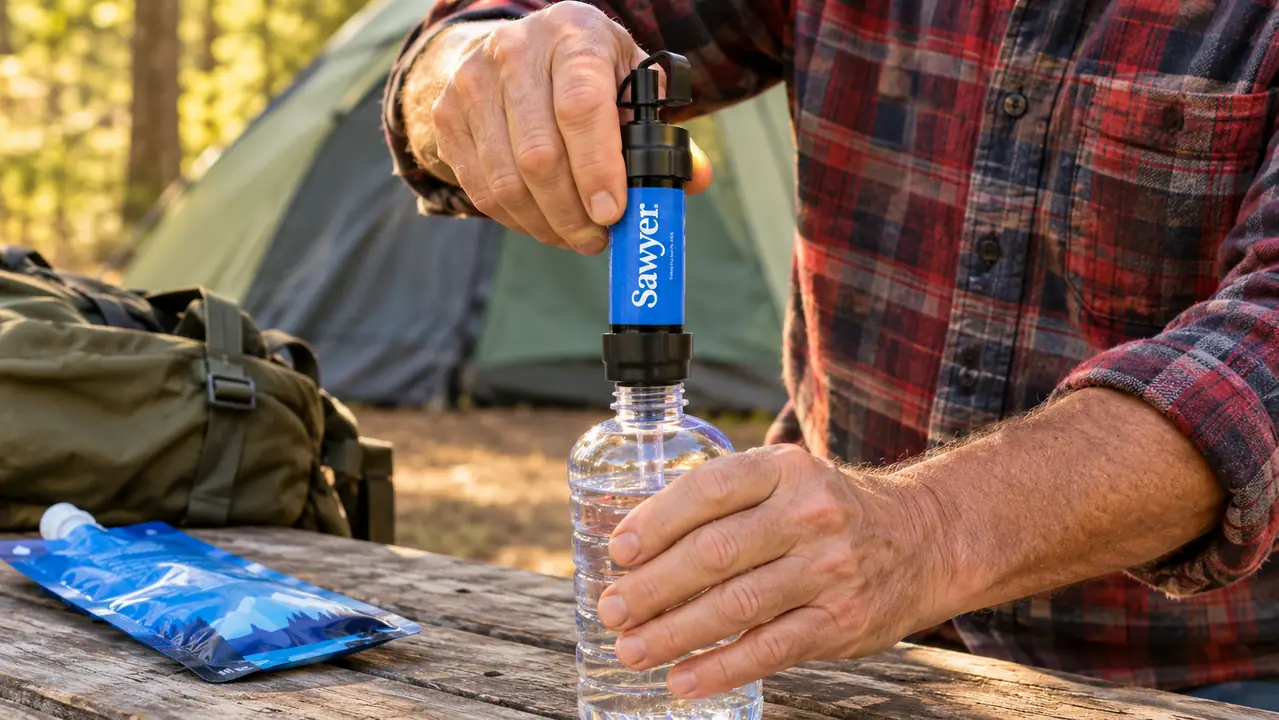
Here is the short answer. The Sawyer Mini is a filter you build a system around. It screws onto the included 16-ounce pouch, a standard 28 mm disposable bottle, or a hydration pack line, and it weighs 2 ounces in the hand. The LifeStraw Personal Filter is a filter you carry and kneel to. You put one end in the water and sip through the top. If you want to fill a bottle for later, the Sawyer wins that job without much argument. If you want to drink the moment you reach the water and never think about threads or pouches, the LifeStraw has a real advantage and I will say so below.
| Sawyer Mini | LifeStraw Personal Filter | |
|---|---|---|
| How you drink | Screws onto the 16-ounce pouch, a 28 mm bottle, or a hydration pack line, so you filter into a container you carry | You lean down and sip directly from the source, no container needed in the moment |
| Filling a bottle for later | Designed for it. Squeeze the pouch through the filter into your bottle or pot | Not what it does. You drink at the water and move on |
| Staying upright while you drink | You stand, or sit on a rock, and drink from your own bottle | Requires kneeling or crouching at the water's edge with your face near the surface |
| Setup before the first sip | A few steps: fill the pouch, thread the filter on, squeeze. Threads have to line up cleanly | Nothing to assemble. Uncap and drink |
| Weight and packed size | 2 ounces, fits in a palm, but the pouch and plunger add bulk to the kit | Roughly the same weight in the hand and slightly simpler to stash, since there is no pouch |
| Backflushing and cleaning | Comes with a cleaning plunger; backflushing is part of the routine and extends the filter's life | Cleaning options are more limited in the field, and the filter is not built for the same maintenance routine |
| Capacity rating | Rated to 100,000 gallons when maintained and backflushed | Rated in the range of a thousand liters, well short of the Sawyer's number |
| Drinking while hiking | Attach it to a hydration pack line and sip as you walk | You stop, kneel, and drink. Not a walking filter |
| Best for | Backpackers and car campers who want water in a bottle or pot for cooking and the day ahead | Day hikers and ultralight travelers who want one simple job done with no parts to lose |
Where the Sawyer Mini Wins
The Sawyer Mini wins on the thing that actually matters to a backpacker: it puts filtered water in a container instead of in your mouth. That sounds like a small distinction until you are the one cooking dinner. On a three-night trip in the Three Sisters, I want water in a pot for rehydrating food, in a bottle for the climb the next morning, and in a second bottle for the walk back to the trailhead. The Sawyer does all three because the pouch is the source and the bottle is the destination. The LifeStraw does none of them.
There is one small number that changed how I plan a trip. A 16-ounce pouch is half a liter, so filling my one-liter bottle for the next morning takes two rounds. Two rounds is also roughly what goes into a pot of rehydrated rice plus a cup of coffee at night. So I count in pouches now: four for dinner and breakfast, six if the next day is long and dry. Standing at a lake at 6:40 in the morning squeezing the fourth pouch through a filter that has started to slow is exactly the moment the capacity rating stops being a brochure number and becomes a chore you either keep up with or you don't. Backflush at home and the fourth pouch moves as fast as the first one did.
The maintenance side is the other clear win, and it is the reason I stopped treating filters as disposable. The Mini ships with a cleaning plunger, and backflushing is a normal part of owning it. Push clean water backward through the hollow fiber membrane and the flow rate comes back. That routine is why Sawyer can rate this thing to 100,000 gallons. My first Mini went four seasons before I gave it away to a friend's kid, still flowing well. The LifeStraw is not built around that same maintenance loop, and its published capacity is measured in the low thousands of liters rather than six figures of gallons. If you want one filter and a decade of use, that gap is the whole argument.
The third win is quieter. The Mini attaches to a hydration pack line, so on a long climb I can sip while I walk and never break stride. On a grade where stopping costs me momentum and my knee reminds me about it, that is not a luxury. It is the difference between drinking enough and not.
The Sawyer does the unglamorous job: it makes water you can put down and carry. The LifeStraw makes water you drink and leave.
Where the LifeStraw Wins
I will not pretend the LifeStraw has nothing. Its great advantage is that it removes steps. There is no pouch to fill, no thread to line up, no chance of cross-threading a filter onto a bottle in the cold with tired hands. You reach the water, you uncap, you drink. On a hot day on a day hike, that is the entire job, done in four seconds.
Two summers ago I borrowed a friend's LifeStraw for an afternoon on a trail above Todd Lake, a hot day in early August, and I understood the appeal in about ten seconds. I had been carrying a bottle, but the bottle was empty by the second mile and the creek was right there. I knelt on a flat rock, put the end in, and drank until I was not thirsty. No pouch, no threads, no water to carry up the hill. If I had been ten years younger and doing day hikes instead of overnights, I might have bought one that same afternoon. What stopped me was the pot of soup I was going to want at seven that evening, and the LifeStraw cannot fill a pot.
It is also the more forgiving filter for someone who is not going to maintain anything. No plunger means no plunger to lose or forget at home. No pouch means no pouch to puncture. If you are the person who buys a filter, uses it six times a summer, and puts it back in the bin, the LifeStraw's simplicity outlasts the Sawyer's capacity rating in practical terms, because the capacity rating only pays off for someone who actually backflushes. There is also the honest physical point that some people cannot comfortably work a squeeze pouch at all. A hand that has lost grip strength, a wrist that does not like the angle, a shoulder that complains, all of those make the sip-through-the-top approach easier. My left knee is the reason I am careful about kneeling, but the Sawyer's real cost is in your hands, not your knees, and it is worth being honest that a squeeze pouch asks something of them.
The filter that fills a bottle, not just a mouthful
If you want water in a pot for dinner and in a bottle for the climb tomorrow, the Sawyer Mini is the one that does it. It packs to 2 ounces, screws onto the included pouch or a standard 28 mm bottle, and comes with the plunger that keeps it flowing for years.
Amazon Check Today's Price on Amazon →One more thing worth saying plainly: neither of these filters removes everything. The Sawyer Mini is a hollow fiber membrane with a 0.1 micron absolute rating, and it is listed as removing essentially all bacteria and protozoa, including Giardia and Cryptosporidium, along with microplastics. It is not a purifier and it does not touch viruses or dissolved chemicals. The LifeStraw has comparable biological claims and the same blind spot. On a Cascade lake or a Three Sisters creek, that is usually an acceptable trade. If you are pulling from a source near a trailhead parking lot, a cattle lease, or a road, biological filtration is not the whole problem and neither of these is the full answer.
The Weight Question, Honestly
Weight is where these two look most alike and where the comparison gets misunderstood. Both are around 2 ounces in the hand. But the Sawyer's kit includes the filter, a 16-ounce pouch, a drinking straw, and the cleaning plunger. That is the real packed weight, and the pouch is the part that takes up room in a side pocket. The LifeStraw travels as one piece with nothing attached.
I did weigh things once, on the kitchen scale, out of curiosity. The filter alone came in at the 2 ounces Sawyer advertises, which read 41 grams on the same scale, and it is genuinely small enough that I once found it in a jacket pocket three weeks after a trip and briefly panicked that I had lost it and bought a second one. The pouch is the piece that actually takes up room. Rolled down it slides into a side pocket, but it bulges, and my back notices a bulge under a hip belt more than it notices two ounces. The plunger is the one piece I have genuinely left on the kitchen counter, which turns a filter rated to 100,000 gallons into a filter with an unknown number.
For a weekend backpacker like me, the difference is not enough to feel in a pack that already carries a stove and a pad my back argues with. For someone counting grams on a thru-hike, the pouch and plunger look like fat until the third day, when the person without a filter system is boiling water to drink it. I would rather carry the extra two ounces of pouch than spend fuel and time boiling. That math lands differently for everyone, which is why I am not going to hand you a number and pretend it settles it.
What I Actually Carry
Dale and I carry the Sawyer Mini as the primary filter and a small backup bottle of treated water in the car. The Mini lives on a hydration pack line on hiking days and on the included pouch on camp days when I am filling a pot. The backflush gets done at home after every trip, with the plunger, over the bathroom sink, which takes about a minute and is the single habit that makes the capacity rating real instead of theoretical.
A cold night taught me the one rule I now follow. We were at a Cascade Lakes campground in late September, the kind of night that drops to freezing and leaves frost on the picnic table by seven in the morning. I left the pouch full of water in the Outback overnight because I was tired and it seemed harmless. In the morning the pouch had frozen solid and the seam had begun to split. Nothing was wrong with the filter. Everything was wrong with me. Now the pouch gets emptied and shaken out before bed, and the filter comes inside in a zip bag with the sleeping bag liner. It is a thirty-second habit and it has saved me the cost of a replacement pouch every season since.
More than 41,000 ratings sit behind this thing at 4.7 stars, and having used it across four seasons I understand why. It is not exciting. It is a small, unglamorous object that keeps working, and the only failures I have seen were failures of the owner: a lost plunger, a pouch left to freeze in a car overnight, a filter that was never backflushed and finally slowed to a trickle. The product held up. The maintenance did not.
What I Liked
- Puts filtered water in a bottle or pot, which the LifeStraw cannot do
- Ships with a cleaning plunger, and backflushing restores flow
- Rated to 100,000 gallons with maintenance
- Attaches to the included pouch, a standard 28 mm bottle, or a hydration pack line
- 2 ounces in the hand, small enough to live in a hip pocket
- Removes essentially all bacteria and protozoa plus microplastics
Where It Falls Short
- Squeezing a pouch takes hand and wrist strength that not everyone has
- Threads must line up cleanly, which is fiddly with cold hands
- The pouch and plunger add packed bulk beyond the 2-ounce filter
- No virus or chemical removal, so source choice still matters
- A lost plunger or a frozen pouch ends the routine until you replace it
Who Should Buy Which
Buy the Sawyer Mini if you are the person who filters water to use later. Backpackers, car campers, anyone cooking rehydrated meals, anyone filling bottles for the next morning, anyone who wants a filter they can maintain for years instead of replace. If your trips involve a pot and a stove, this is the one. If you have a stiff knee and would rather stand while you drink, this is also the one. If you have limited grip strength and squeezing sounds like a chore, that is a genuine reason to pause and think about the other option.
Buy the LifeStraw Personal Filter if your water needs are simple and immediate. Day hikes with a reservoir you filled at home, a short walk to a lake, travel where you want nothing to assemble or maintain. It is also the better pick for someone who knows they will never backflush anything. A filter that gets used without maintenance beats an excellent filter that sits in a bin because the routine felt like homework. And if you are choosing for a teenager or a friend who wants zero moving parts, the LifeStraw is the kind thing to hand them.
If you are at all unsure, buy the Sawyer and one extra pouch. The Mini is the more capable tool, the pouch is what makes it useful, and a spare pouch costs less than a second filter. That is the setup I would put in anyone's pack.
One filter, a pot of water, and no more boiling
The Sawyer Mini is the one I keep packed. Rated to 100,000 gallons, 2 ounces in the hand, and it fills a bottle instead of just quenching a mouthful. If you want filtered water for dinner and for the trail tomorrow, this is the piece of kit that does it.
Amazon Check Today's Price on Amazon →