
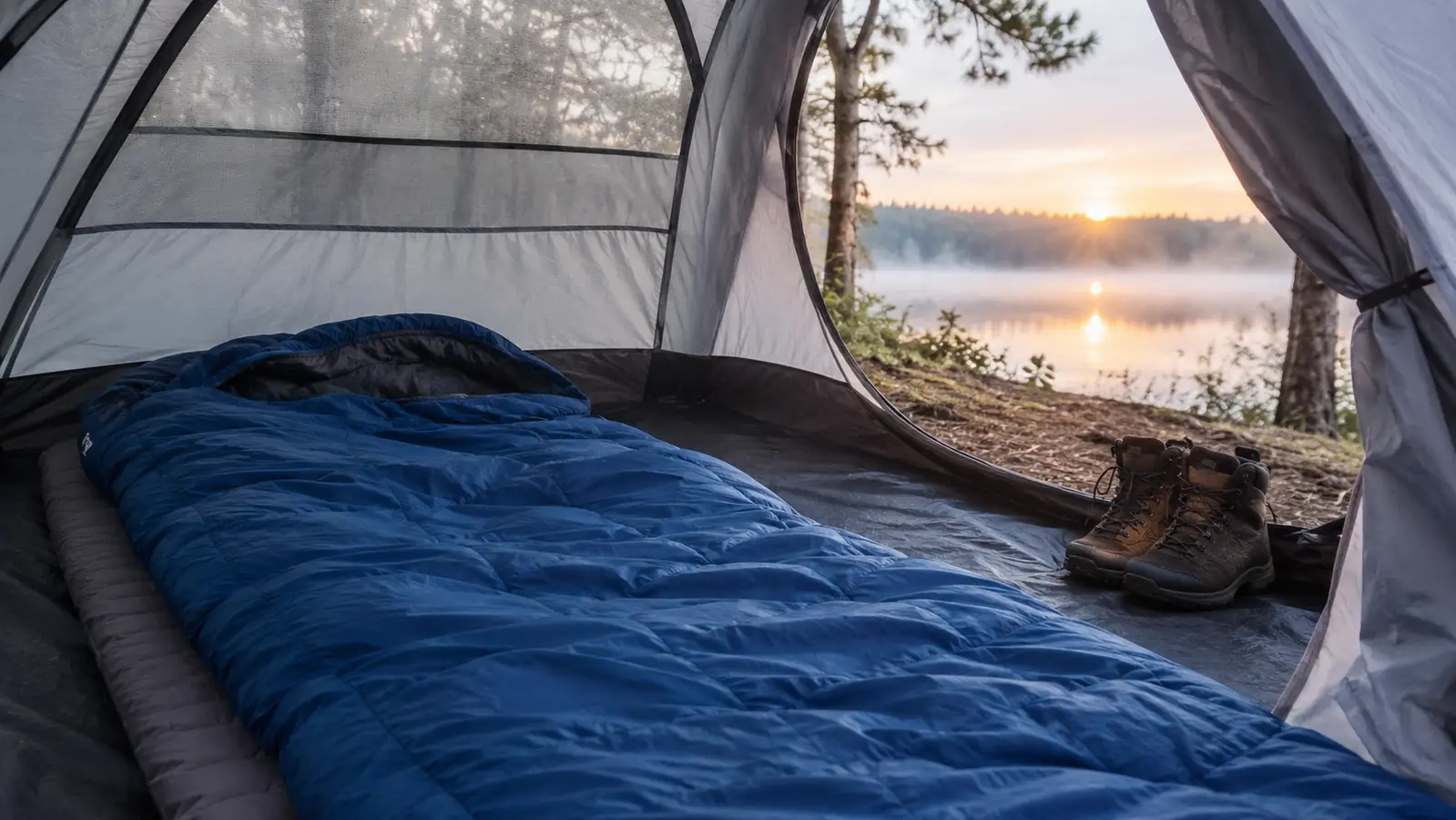
The Gear Doctors Oxylus entered my life because my back staged a revolt. Four years ago I bought a closed-cell foam pad at a hardware store here in Bend, the accordion kind, and for a long time it was fine, in the way that sleeping on the floor is fine until it is not. Last September, on the second night of a trip into the Three Sisters Wilderness, I woke at four in the morning with my left hip aching and my lower back locked up, and I lay there listening to Dale breathe and thinking unkind thoughts about my own thrift. I am 61. My left knee has been stiff since a ski injury in my thirties, and my back has firm opinions about anything thinner than a couple of inches.
So in March I ordered the Oxylus, a self-inflating pad from Gear Doctors that measures 72 inches long, 22 inches wide and 1.5 inches thick, weighs 2.2 pounds, and carries a 4.3 R-value. It is rated to 250 pounds, it ships with a carry bag and a repair patch, and it is rectangular rather than tapered, which matters more than people expect when you are turning over at two in the morning in a narrow tent. I have slept on it for eleven nights now: five car camping at a Cascade Lakes campground in May, four across a two-night loop in the Three Sisters in June, and two in the backyard in July when I wanted a cold-night test without the drive. This is the honest version, including the parts I do not love.
The Quick Verdict
A warm, quiet, well-made self-inflater that solved my cold-ground problem at 2.2 pounds. It is 1.5 inches thick, and that one number decides whether it suits you.
Amazon Check Today's Price →The pad that ended my four-in-the-morning hip ache
Gear Doctors built the Oxylus around a 4.3 R-value core and a 72 by 22 sleeping surface at 2.2 pounds. It is the pad I keep rolled in the back of the Outback for cold shoulder-season nights.
Amazon Check Today's Price on Amazon →What the Oxylus Actually Is, and What It Is Not
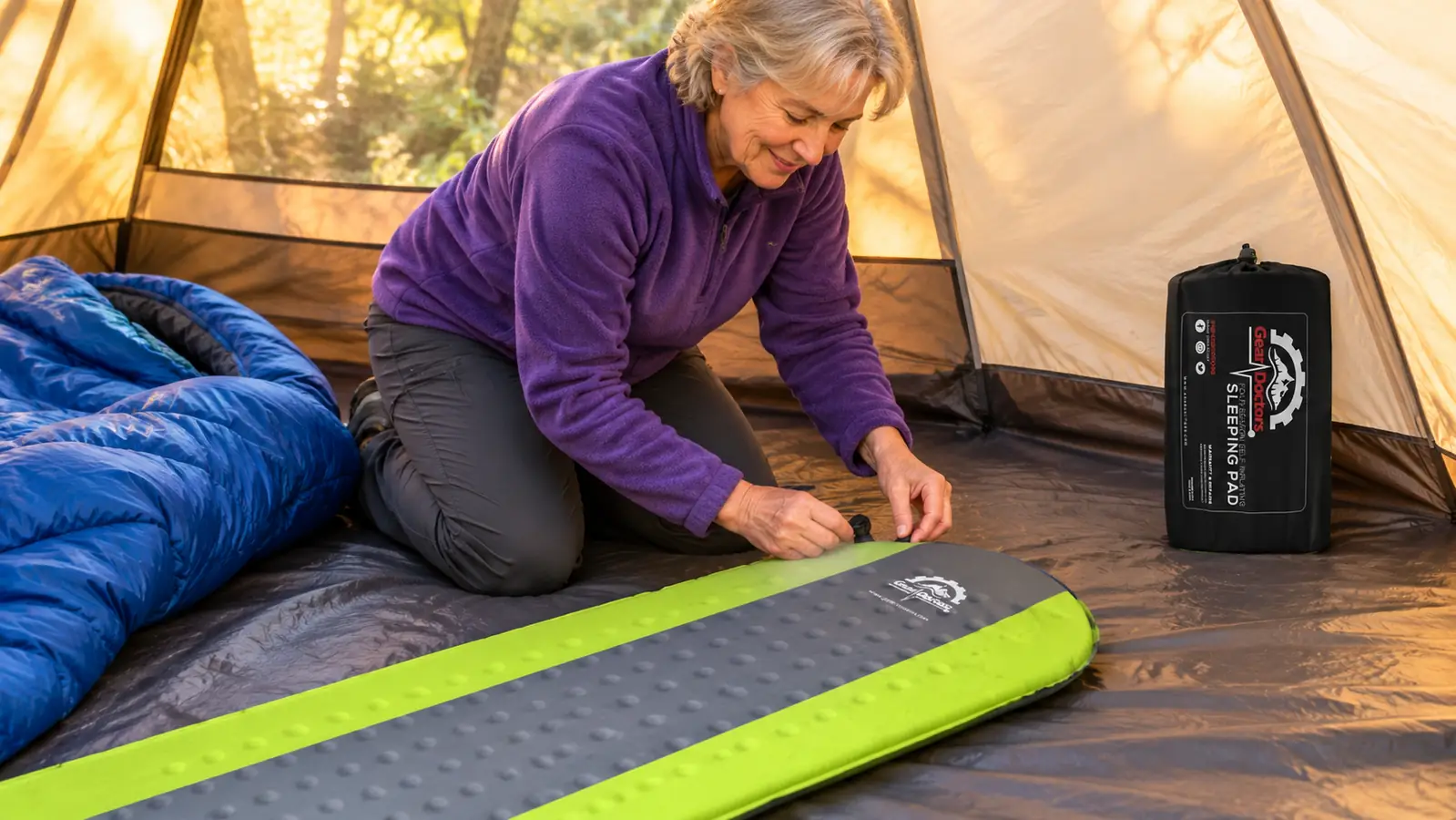
Let me be precise, because the listing copy is dense and this category confuses people. The Oxylus is a self-inflating pad. That means there is open-cell foam bonded inside the fabric. You unroll it, open the valve, and the foam slowly pulls air in until the pad is roughly full, then you close the valve and lie down. The listing promises pack to sleep-ready in under five minutes, and that matches what I have seen, though the first minute or two is the pad working and the rest is me pitching the tent and digging out my sleeping bag.
The numbers, all taken from the listing: 4.3 R-value, 72 inches by 22 inches by 1.5 inches, 2.2 pounds, 250-pound capacity, medium firmness, rectangular, single size. In the box: a carry bag and a repair patch. What it is not: it is not an ultralight pad, it is not a thick pad, and there is no pump, no pump sack, and no electronics. There is a valve and there is foam, and that is the entire system.
Simplicity is the argument for it. I once watched a friend's integrated pump quit on the second night of a trip while my old closed-cell mat kept doing its one job without complaint. A self-inflater has very little to break. The Oxylus adds an insulated core to that tradition, and the insulated core is the reason I bought it rather than another foam mat.
How I Have Used It, Trip by Trip
The May trip was car camping, which for us means the Outback is stuffed to the windows and nothing has to be light. Nighttime temperatures sat around 38 degrees. I unrolled the pad on the tent floor, opened the valve, and went off to start dinner. By the time I came back it had taken its shape. I closed the valve and lay down, and the first thing I noticed was the quiet. Foam mats do not crinkle and neither does this pad. The second thing I noticed was that the ground was not cold. That sounds small. After four years of a half-inch foam mat, it was not small.
We were in site 12 at a Cascade Lakes campground, the one with the tree root that has ruined my sleep twice. I tried laying my old closed-cell mat on top of the Oxylus the first night, a belt-and-suspenders arrangement I had been carrying around in my head for months, and it slid sideways within an hour and made the whole setup worse. The second night I used the Oxylus alone and never noticed the root at all. Dale, who had watched the whole experiment without comment, said only that I might have saved myself the trouble by trying the plain version first.
The June trip was the real test, a two-night loop out of the Three Sisters trailhead with Dale. The pad weighed 2.2 pounds, which made it the heaviest single item in my pack after the tent. That is the honest cost of an insulated self-inflater, and I felt it on the climb. What I got for it was two nights of real sleep at the end of two long days. At my age that is the difference between enjoying the third morning and merely surviving it.
The backyard test was the one I trusted most, because it was boring and controlled. I set the tent up on the lawn on a night forecast to hit 29 degrees, slept out in long johns, and woke at six. The cold never came up through the pad. I want to be careful about how I say that. The air was cold, my sleeping bag did its job, and the pad refused to leak my heat into the ground. That is all a pad can do, and it did it.
The 1.5-Inch Question, Which Is Really the Whole Review
Here is the thing you will not find in the first paragraph of a typical write-up. This pad is 1.5 inches thick. Not three, not four. On the hard floor of my kitchen it feels like a well-padded carpet. On forest duff, which is what most of us actually sleep on, it feels like a bed. The difference between those two surfaces tells you almost everything about who this pad suits and who it does not.
I weigh about 148 pounds and I sleep on my side. At that weight, on the ground I camp on, 1.5 inches is enough that my hip does not wake me. Dale is heavier than I am and moves around more, and his verdict was that it was adequate and that he would want more loft for anything longer than two nights. If you are over 200 pounds, or a devoted side sleeper with wide hips, or you routinely pitch on packed gravel and hardpan, the thickness is the number to think about before anything else here. The 250-pound capacity is a structural rating, not a comfort rating. Those are two different questions and the listing only answers one of them.
I tested that distinction directly. One afternoon in April I laid the pad out on the concrete apron of our driveway, which is about as unforgiving as ground gets short of bare granite, and lay on it for twenty minutes with a book propped on my chest. It was perfectly fine for twenty minutes. I would not have wanted eight hours on it, and I knew that by the time I stood up. On the duff and pine needles at our usual sites, eight hours is exactly what I get, and that is the entire reason this pad works for me and would not work for everyone.
Compared with what I came from, this is a genuine step up. A closed-cell mat is roughly half an inch of foam and it does not get thicker, ever. Compared with the four-inch air pads some of my friends carry, it is a different class of object, and I have slept badly on one of those because the baffles fought my back all night. Thickness is not the same as comfort. It is, however, the first thing to rule out.
Warmth: What a 4.3 R-Value Felt Like on Cold Ground
R-value measures resistance to heat flow. For sleeping pads the working shorthand is this: under 2 is summer only, 2 to 4 is three-season, and above 4 is cold-weather ground. At 4.3, the Oxylus sits at the bottom of that cold-weather band, which for a shoulder-season camper in Central Oregon is exactly right and for a January snow camper is not enough.
Two nights on the June trip dropped to 29 degrees. I had a bag rated for 20, a wool hat, and this pad, and I slept through until about five. On the May trip at 38 degrees I was actively comfortable, which is unusual for me, because I am a person who notices cold in her shoulders and her feet. The pad is not radiating heat. It is simply refusing to let the ground pull heat out of you, and it does that job without any fuss.
Two nights at 29 degrees and the cold never came up through the pad. The only thing I felt was my own hip, and that is a thickness problem, not a warmth problem.
One caveat that has nothing to do with this pad in particular: an R-value assumes the pad is fully inflated. A self-inflater that has gone soft overnight is a thinner pad and a colder one. Let it deflate and you lose cushion and warmth together, and you will blame the pad when the fault was at the valve.

Setting It Up Right the First Time
Unroll it the day it arrives and leave it out on the living room floor with the valve open for a few hours. The foam in a new self-inflater has been compressed in a box and it needs a couple of cycles to remember its shape. I did this on a Saturday while I was doing laundry, rolled it back up, and by the second trip it was reaching full loft on its own in about four minutes rather than needing the whole five.
Close the valve later rather than sooner. A self-inflater keeps drawing air until the foam stops pulling, and if you shut it off early you get a thin, soft pad that will not keep you warm no matter what the R-value says on the box. Mine takes about four minutes to look full and I give it a fifth. When I want it softer I open the valve, press down on the pad with my knees, let a little air escape, and close it again.
I timed it on the kitchen floor with the timer on the stove, because I am that sort of person now. On day one it was still noticeably soft at four minutes and I had to wait it out. After the third trip it looked full at three and had settled by four. That gap sounds trivial until you are lying on it at 38 degrees, where the difference between a properly filled pad and a half-filled one is the difference between warm and merely not cold.
Two small habits. First, put the repair patch in your pack, not in the drawer at home. It came in the box and it weighs nothing. Second, pitch on the smoothest ground you can find and clear the sticks and pine cones first, because 1.5 inches of foam will telegraph a good-sized root straight into your ribs. That is not a flaw in the pad. It is physics, and it applies to every pad this thin.
Inflation, Deflation, and the Small Annoyances
Pack-up takes me about three minutes. Open the valve, fold the pad in thirds, roll from the foot end, and the air goes out ahead of the roll. It has never fought me. The foam was stiff the first two times I unrolled it and wanted help reaching full loft. By the fourth trip it was opening up on its own. That is normal for self-inflaters, and it is worth knowing so you do not judge the pad on night one.
The one genuine annoyance is that the valve has to be seated firmly. On my first night I thought I had closed it and I had not, not quite, and by two in the morning the pad had softened under my hip. That was my error rather than a defect, but a self-inflater with a half-closed valve is a worse night than a foam mat. Now I check it twice, once when I close it and once before I get in.
The other cost is bulk. At 2.2 pounds this is a reasonable weight for an insulated self-inflater, but a rectangular pad rolls into a bigger bundle than the number suggests, and it takes more room in my pack than my old mat did. For car camping that is irrelevant. For a two-night backpack it is a real line item, and I noticed it. I would not carry it on a five-day trip.
On the June loop I strapped it under the lid instead of burying it in the main bag, which worked, but it made the pack sit higher than I like on the descents and I felt it in my left knee by the second afternoon. Dale carried his inside his pack and had nothing to report, so this may be a me problem rather than a pad problem. Either way, budget for the space and not just the weight, because the space is what surprised me.
What I Liked
- 4.3 R-value kept me warm on nights near freezing
- Self-inflating design means no pump and no electronics to fail
- 2.2 pounds is reasonable for an insulated self-inflater
- 72 by 22 rectangular surface gives room to turn over
- Quiet, with no crinkling or squeaking when you shift
- Carry bag and repair patch both included
Where It Falls Short
- 1.5 inches is thin for heavier side sleepers
- Packs bulkier than the weight suggests
- Foam needs several uses before it reaches full loft on its own
- The valve has to be seated firmly or the pad softens overnight
- Not an ultralight choice for long-distance backpacking
Who This Is For
This pad is for the camper who wants warmth and a decent night without carrying a pump or trusting electronics, and who is not chasing an ultralight base weight. If you car camp and want a pad that lives rolled in the back of the vehicle from May to October, this is a good one. If you take two- or three-night backpacking trips in shoulder season and you are somewhere under 180 pounds, it will very likely suit you. It is also a sensible first purchase for anyone who has been cold at night and cannot work out why, because the answer is almost always the pad, and this one answers that question.
Who Should Skip It
Skip it if you need four inches of loft, if you are a committed side sleeper well over 200 pounds, or if pack volume is the thing you optimize first. Skip it if you camp in real winter, because 4.3 is a shoulder-season number and snow camping wants more underneath you. Skip it if your tent is a narrow one-person model with no vestibule, because a 72 by 22 rectangular pad fills that floor edge to edge. And skip it if you want a pad you can fill from a pump sack in thirty seconds, because that is a different product with a different set of failure points.
Warm ground, honest comfort, one tradeoff you should accept knowingly
The Oxylus gives you a 4.3 R-value core and a 72 by 22 sleeping surface at 2.2 pounds, and asks you to accept 1.5 inches of loft. After eleven nights, I would buy it again.
Amazon Check Today's Price on Amazon →