
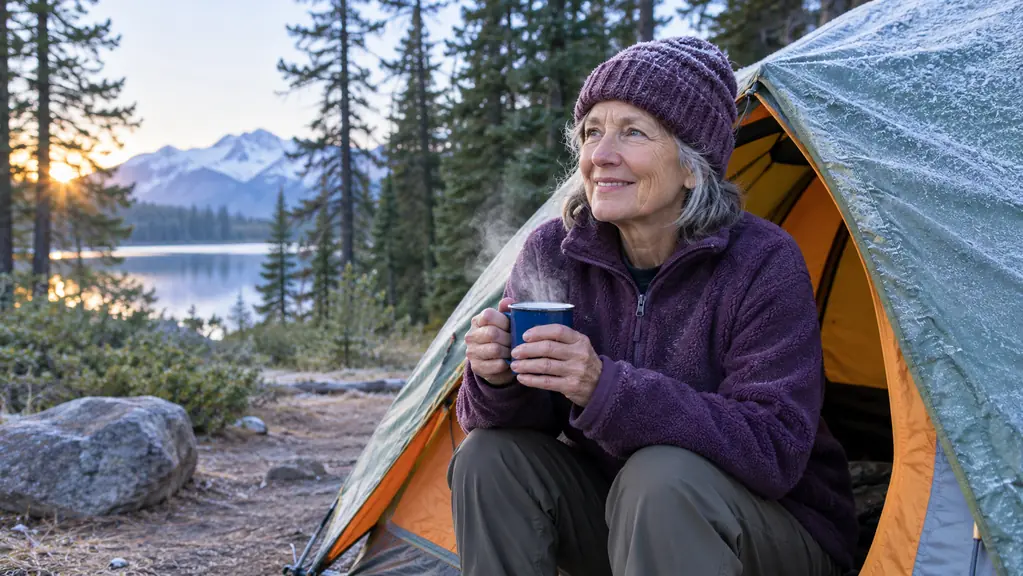
The coldest night of my camping life was not on a mountain. It was late September at a Cascade Lakes campground, twenty feet from a 2014 Subaru Outback with a working heater in it. I woke at 2:40 in the morning with my shoulders hunched up around my ears and my feet like two river rocks, and I lay there doing arithmetic on how many hours of misery stood between me and daylight. I had a bag rated for cold weather. I was still cold. These days the bag inside my system is the TETON Sports 20F mummy, a 2.9 pound synthetic bag with a hood, a zipper draft tube and a vaulted footbox. It is warm enough for the trips I actually take, provided I get the other four things right.
What I have worked out since, over a lot of shoulder-season nights in the Three Sisters Wilderness and a lot of mornings where the tent fly is stiff with frost, is that staying warm is mostly plumbing. Heat leaves you at roughly the rate it escapes, and it escapes in four places: down into the ground under your body, out through damp clothing, out the openings around your head and feet, and into your own insulation once that insulation gets wet. Plug the leaks and a modest bag feels generous. Ignore them and the warmest bag in the catalog feels like a sheet of newspaper.
The bag I stopped arguing with at 3 a.m.
The TETON Sports 20F mummy has a hood that closes around your face, a draft tube behind the zipper, and a footbox with room for your toes. Survival rated to +20F, and honest about the rest.
Amazon Check Today's Price on Amazon →Step 1: Insulate the ground before you touch the bag
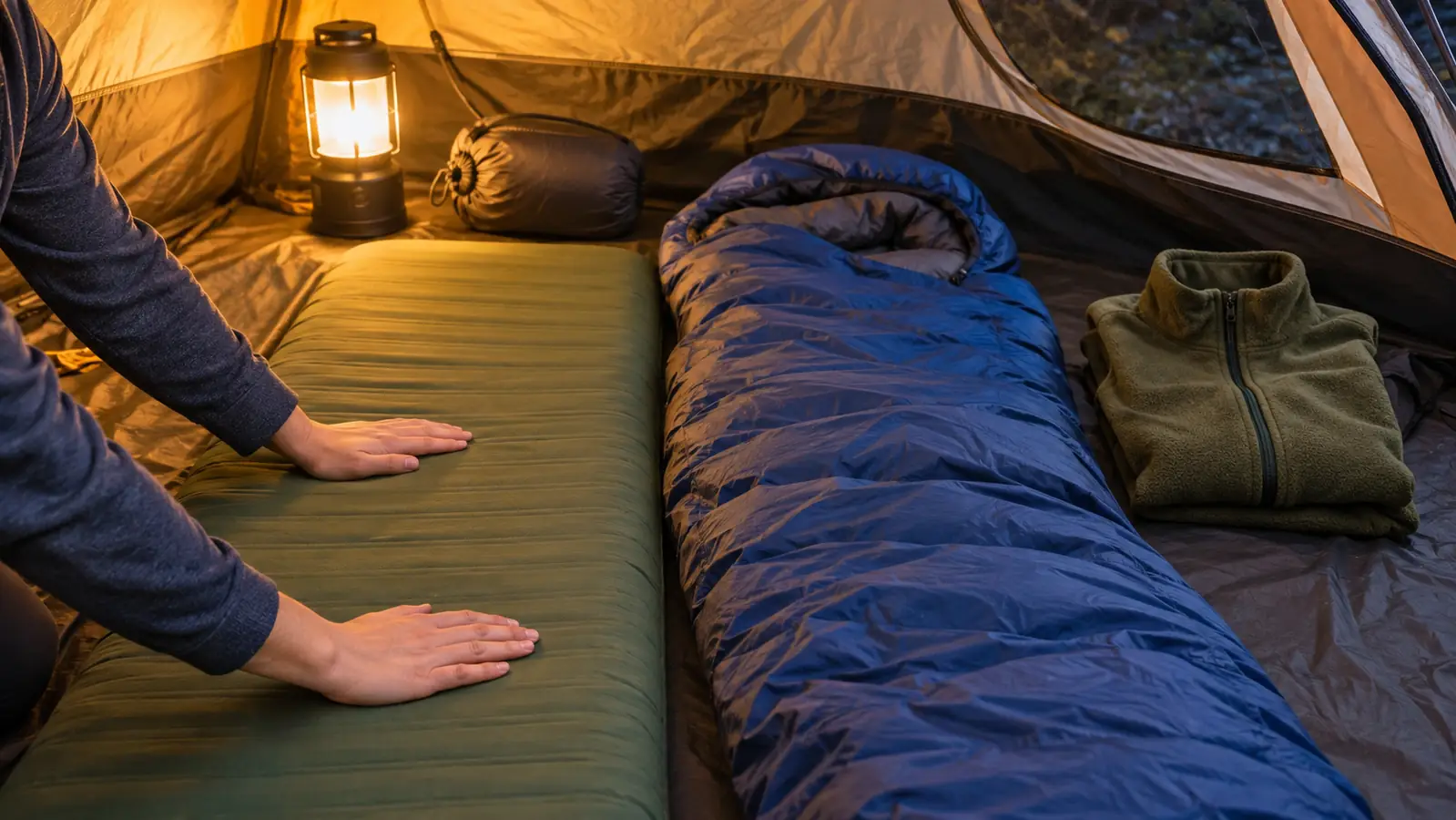
Heat leaves a sleeper in two directions. Up is the one everybody thinks about. Down is the one that ruins the night. Cold ground pulls heat out of you by conduction, and it does that faster than cold air does because there is far more contact. I have a stiff left knee from an old ski injury that aches for two days if I sleep on a cold floor, and my back has strong opinions about thin pads, so none of this is theoretical for me. Here is the part people miss: the insulation under your body compresses to almost nothing beneath your weight. It is not doing much work. The pad is doing that work.
Car camping out of the Outback, I bring a thick self-inflating pad and I do not apologize for the bulk. Backpacking, I bring closed-cell foam and accept that I will sleep less well and wake with a back that needs a few minutes before it agrees to stand. What matters is that the pad is warmer than the ground and long enough to cover you from shoulders to hips. A short thick pad beats a long thin one every time. If the forecast has the overnight low near freezing, I double up, foam under inflatable, which costs maybe half a pound and turns a bad night into a decent one. Dale thought I was overpacking until he borrowed the foam pad in August and then asked for one of his own.
The first time I tried to solve this cheaply I put a folded wool blanket under the bag instead of buying a second pad. It worked for about two hours and then the blanket migrated out from under my hips, which is exactly where I needed it, and I spent the rest of the night chasing it back into place with my heels. A pad that stays put is worth more than a blanket that does not. If you are sleeping on an air mattress in a car-camping tent, check it before bed with your hand along the seams; a slow leak that lets you down two inches by midnight feels like a completely different night than the one you planned.
Step 2: Sleep in clothes that are dry, not clothes that are warm
The instinct is to wear everything you brought. The better move is to wear one dry set and keep that set dry. Cotton is the enemy here. It holds moisture against your skin and then conducts heat away from you for the rest of the night. Wear a long-sleeve synthetic or wool base layer, dry socks and a hat, and stop there. If you are chilly getting in, you will be warm within ten minutes. If you are still cold after twenty, the problem is under you or around you, not in your clothing, and adding a third fleece will not fix it.
The other half of this is what you wore all day. Hiking clothes carry sweat even when they feel dry to the touch, and moisture is the thing that flattens loft. I change into the dry set right before bed every single time, even when it is cold enough that changing is genuinely unpleasant. Those two unpleasant minutes buy me an hour of not shivering at 3 a.m. The dry set lives in its own stuff sack so it does not sponge up damp from the tent floor. It sounds fussy. It is the cheapest warmth in this entire article.
I learned the sock part of this on a two-night trip in the Three Sisters in early October, when I told myself my hiking socks felt dry enough and got in with them anyway. By eleven they were cold and clammy and I could feel the chill moving up from my ankles. I got up, dug out the sleeping socks, and the difference was not subtle. Now the sleeping socks live in the bottom of the bag during the day so they are never in question. One pair, wool, reserved, and never worn inside a hiking boot.
Step 3: Close the three openings
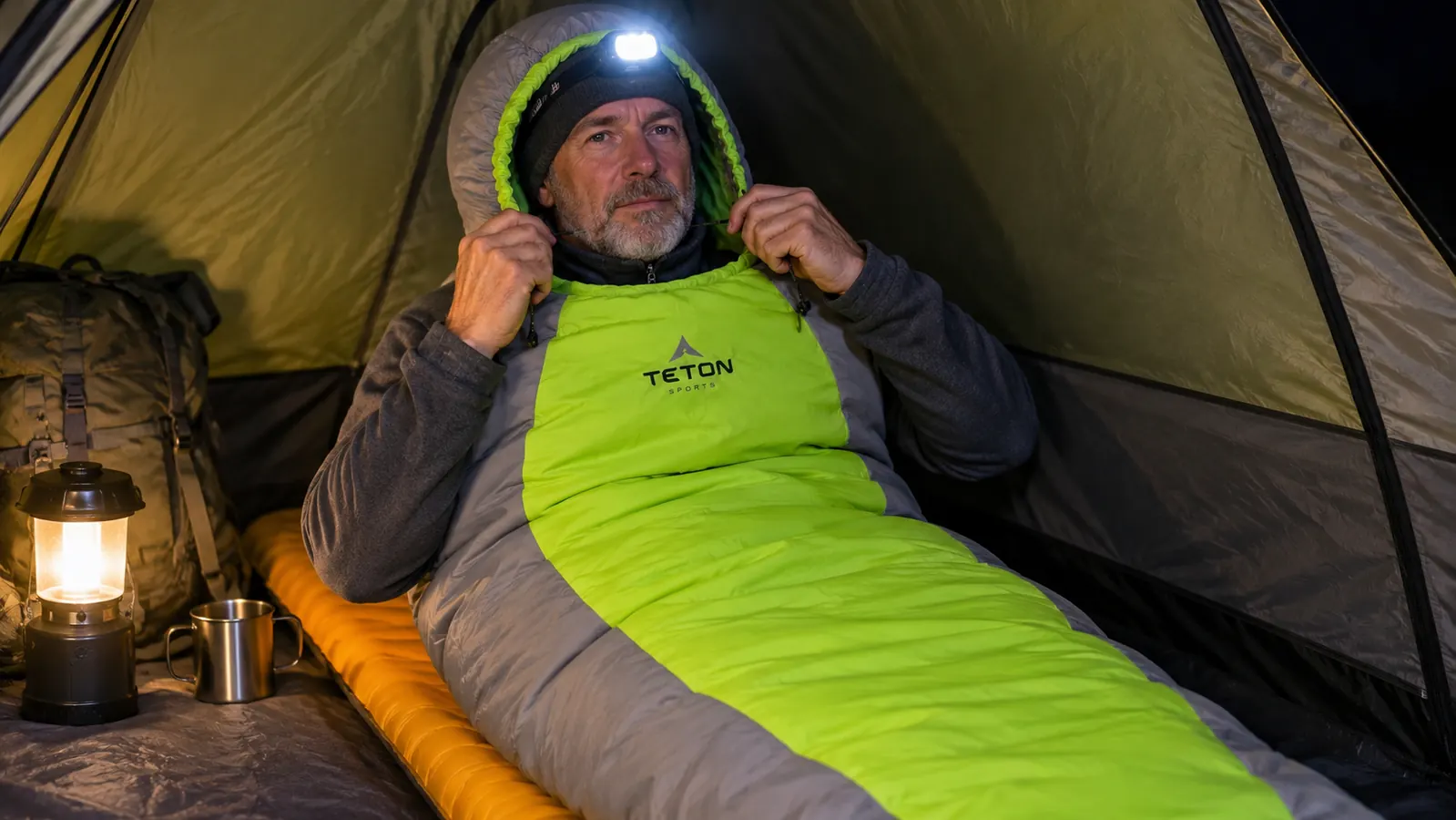
The TETON Sports 20F mummy has three features built for exactly this job, and using them properly is worth more than a pile of extra fill. The first is the hood, designed to close around your head and face. Cinch it until it seals, leaving a small opening to breathe through. Your head is a big chunk of your surface area, and an open hood is an open window. The second is the zipper draft tube, a tube of fabric sitting behind the zipper teeth that blocks the cold air seeping through the seam. It only works if the zipper is fully closed and the tube is lying flat, so I run a hand along it before I settle in. Skipping that costs me an hour of sleep every time I skip it.
The third is the vaulted footbox, which is the part that gives your feet room to move instead of pinning them flat. Cold feet are usually compressed feet. If your toes are jammed against the end of the bag, the insulation there is crushed and doing nothing, and you feel it within the hour. The TETON Sports bag measures 87 inches long by 32 inches wide, and the listing says it fits someone up to 7 feet, so at my height there is slack at the bottom. I push the bag down at the end so the footbox stays puffy rather than stretched tight, and I keep a pair of dry wool socks reserved for sleeping only. Not the socks I hiked in. Different socks.
There is one more opening nobody mentions, and it is the one between the bag and the pad. If you roll in your sleep, and I do, you can end up half off the pad with a shoulder on bare tent floor and no idea how you got there. I put the pad inside a fitted sheet or lay a thin closed-cell pad on top of the inflatable one so the surface has a little grip. It sounds ridiculous until the first night you wake up at four in the morning with your hip on the ground and understand exactly what happened.
The number printed on a bag is the temperature at which you survive the night. It is not the temperature at which you sleep well. Those are two different numbers, and only one of them makes it onto the label.
Step 4: Read the temperature rating the way the manufacturer actually wrote it
This is where people get burned. The TETON Sports 20F is survival rated to +20F, and the listing is unusually candid about the rest: comfort is rated 20 to 30 degrees higher than that. So the number is the temperature at which you get through the night, not the temperature at which you sleep well. Realistic comfort for this bag lands somewhere in the 40s. If the forecast low is 45, this bag plus a decent pad plus dry clothes plus a hat is a genuinely pleasant night. If the forecast low is 25, this bag on its own is not going to be pleasant and you should know that before you drive three hours to find out.
I would rather a manufacturer tell me this than flatter me, because it also means the bag is more capable than the number implies for the trips most of us actually take, which are summer and early fall nights in the 40s and 50s. And the +20F survival figure is doing real work on the shoulder trips. What earns this bag its place in my gear bin is being 2.9 pounds and compressible into the included sack, which matters to a 61 year old with a back that has opinions about pack weight. On the genuinely cold trips I add a liner or I simply plan around the forecast. Knowing which trip you are on is the whole skill.
The practical version of this is a small notebook. I write down the forecast low, what I slept in, and whether I was warm, neutral or cold, and after two seasons I can look at a forecast for a night at Hosmer Lake and know exactly what to bring. The year I started doing that was the year I stopped carrying a spare fleece I never used and started bringing a better pad instead. Gear decisions get much easier once you have your own numbers instead of a label's.
Step 5: Manage moisture overnight, then handle the 3 a.m. problem
You sweat while you sleep. Not much, but some, and that moisture ends up in the insulation. Synthetic microfiber handles it better than down does, which is one good reason a synthetic bag is a sensible pick for damp Pacific Northwest shoulder seasons. The TETON Sports shell is ripstop polyester over microfiber insulation, and it keeps lofting when it is a little damp, but it is not immune and neither is anything else. So vent the tent. Leave the door cracked unless it is raining. Do not zip yourself into a sealed plastic box and then wonder why everything inside it is wet by morning.
Then there is 3 a.m., which is when a cold night stops being uncomfortable and starts being long. If you wake up cold, do not just lie there being stoic. Eat something. Your body is a furnace and a furnace needs fuel, and a handful of nuts at three in the morning is worth more than another layer. Do a couple of minutes of gentle movement inside the bag to get blood back into your feet. Check the obvious things in order: is the pad still under you, is the hood still cinched, is the draft tube flat. Half the time the answer is one of those three, and the other half it is hunger.
And when you get up in the dark, which you will, do it fast and get back in fast. Standing around outside the tent at 3 a.m. admiring the stars is how a warm bag becomes a cold one, because the bag loses its heat to the air the moment you climb out. I keep a headlamp and my shoes by the door in the same spot every night so I am not fumbling. Two minutes outside, back in, hood cinched, and the heat comes back within five.
What Else Helps
A few small things that are not steps but still matter. A hot water bottle inside a wool sock at the foot of the bag is old advice and it still works; I boil water before bed and it is still faintly warm at dawn. Use the bathroom before you sleep, because a full bladder makes you cold and the trip at ten at night is far less awful than the trip at two. Eat a real dinner with some fat in it. Store the bag loosely stuffed rather than compressed when you are not carrying it, so the insulation is not sitting crushed in a sack for months at a time. If you are car camping, throw the bag in the car during the day instead of leaving it in a sunless tent, because a dry bag is a warm bag. For the longer notes on how this one has held up across a couple of seasons, and for how it stacks up against down, I wrote those up separately and they are worth a look before you decide.
Warm enough for the nights you actually camp
The TETON Sports 20F mummy: 2.9 pounds, microfiber synthetic loft, a hood that seals, a draft tube behind the zipper and a vaulted footbox. Packs down into the compression sack that comes with it.
Amazon Check Today's Price on Amazon →