
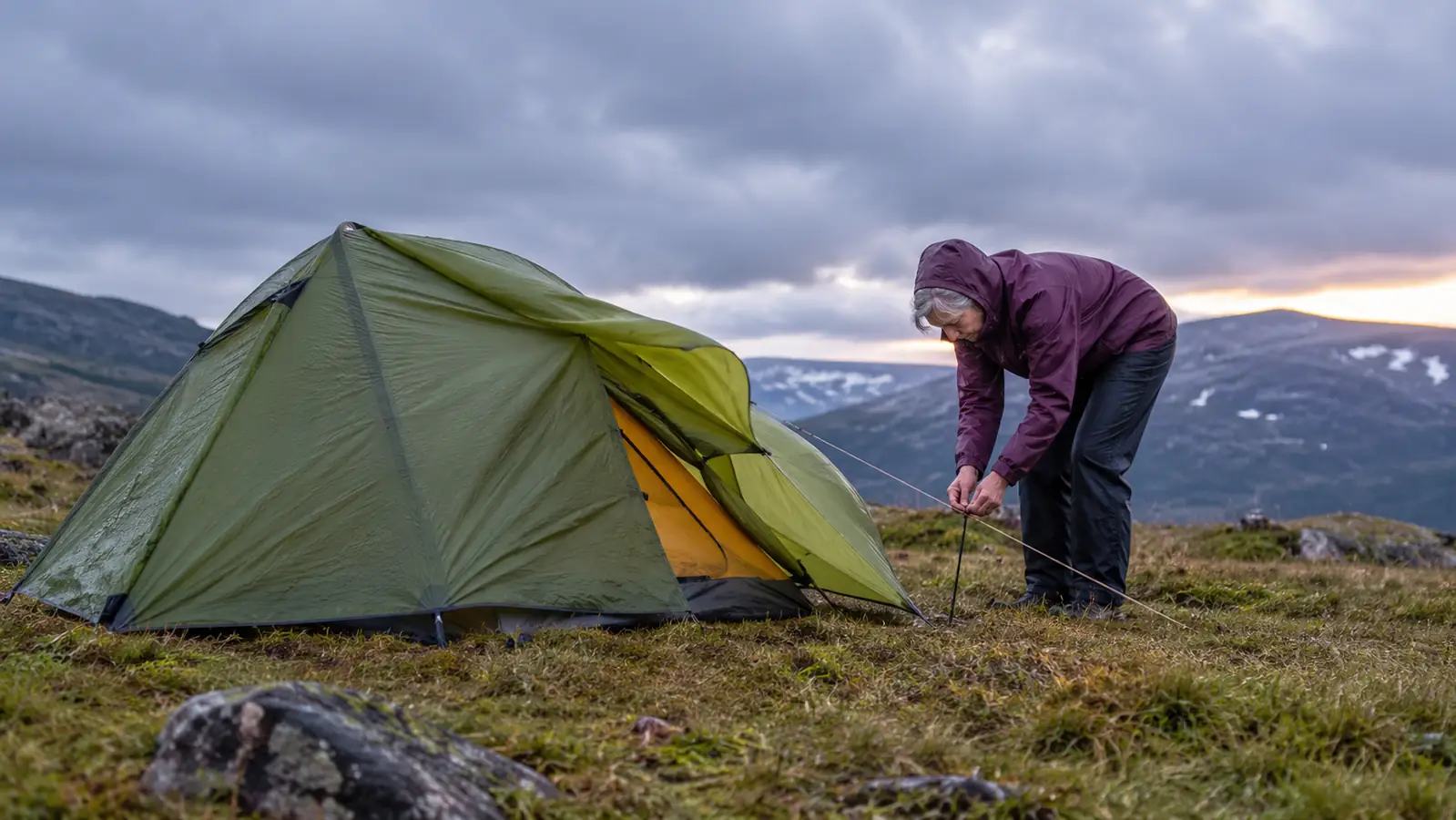
The wind shows up at the worst possible moment. You have walked six miles, your left knee has started its evening complaint, and the lake you planned to sleep beside has turned into a wind tunnel with a grey wall behind it. That is the moment you unclip the tent, and the stuff sack turns into a flag.
I have made most of the available mistakes. Pitched side-on to the wind and spent the night listening to the fly crack like a loose tarp. Watched an unweighted tent body roll across a meadow while I hopped after it with one boot on. Lost a stake bag in the dark and found it three weeks later. What I do now is the same five things in the same order every time the forecast looks doubtful. It takes about nine minutes, and it has kept me dry through some genuinely ugly evenings in the Three Sisters. The tent I use for this is the Naturehike Cloud-Up 2, partly because a free-standing design with clips gives you something to work with when the ground is poor and the weather is already on you.
The tent that goes up fast enough to beat the rain
The Naturehike Cloud-Up 2 is a three-season, free-standing two-person tent that clips to its poles, weighs 4.3 pounds, and comes with a footprint and five wind ropes. Quick to stand up when the sky has already decided.
Amazon Check Today's Price on Amazon →Step 1: Read the ground before you unclip anything
Stand still for a minute and look up before you look down. The most common way a wet night goes wrong is not the tent, it is a branch the size of your arm coming down at two in the morning. Dead limbs, half-hung trees, and anything the wind can reach matter more than a soft patch of moss. I have moved a pitch after dark because of a creaking snag, and I would do it again without grumbling.
Then the ground. You want a slight rise, not the smooth flat spot everyone else has already walked away from for good reason. Water goes to the low point, and the low point is where the puddles gather by midnight. Shoulder-season ground near the Cascade Lakes is often soaked before I arrive, so I am looking for ground that drains rather than ground that merely looks dry.
Two Septembers ago, on the bench above Green Lakes, I watched a couple pitch on the flattest, smoothest patch in the basin. Lovely spot. By eleven that night their floor had a puddle in the middle and both sleeping bags were pushed out to the edges. The ground I took was lumpier and had a slight tilt, which meant I slid a couple of inches downhill in the night and slept fine. To test drainage without digging, kneel down and press your palm flat into the soil. If water beads up around your hand within a few seconds, that patch will be holding water by midnight. If it soaks straight in, you have found your spot.
Wind direction decides the rest of the layout. Stand with the wind on the back of your neck and set the tent so the low foot end faces into it, with the door downwind. That one choice does more for the noise inside than anything you do later with guy lines. If a stand of lodgepole or a big boulder gives you a natural windbreak, use it, but leave a gap so air still moves and condensation has somewhere to go.
Step 2: Stake the upwind corners before you build anything
Now open the bag. The Cloud-Up 2 comes with a footprint, and in wet weather the footprint goes down first, folded so its edges sit inside the tent floor rather than sticking out like a tray to catch rain. A footprint that pokes out past the floor channels water under the tent instead of away from it, which is the opposite of the job.
Stake the two upwind corners before anything else happens. Two stakes into the wind side stop the whole business from turning into a kite while your hands are busy. On loose ground, or if the gusts are already pushing hard, put a stake in all four corners and deal with the door lashings later. Then put something heavy on the fabric: a pack, a full water bottle, a bear canister. I keep one hand on the tent at all times and I do not let go until the poles are clipped in.
Step 3: Assemble the poles low and downwind of your body
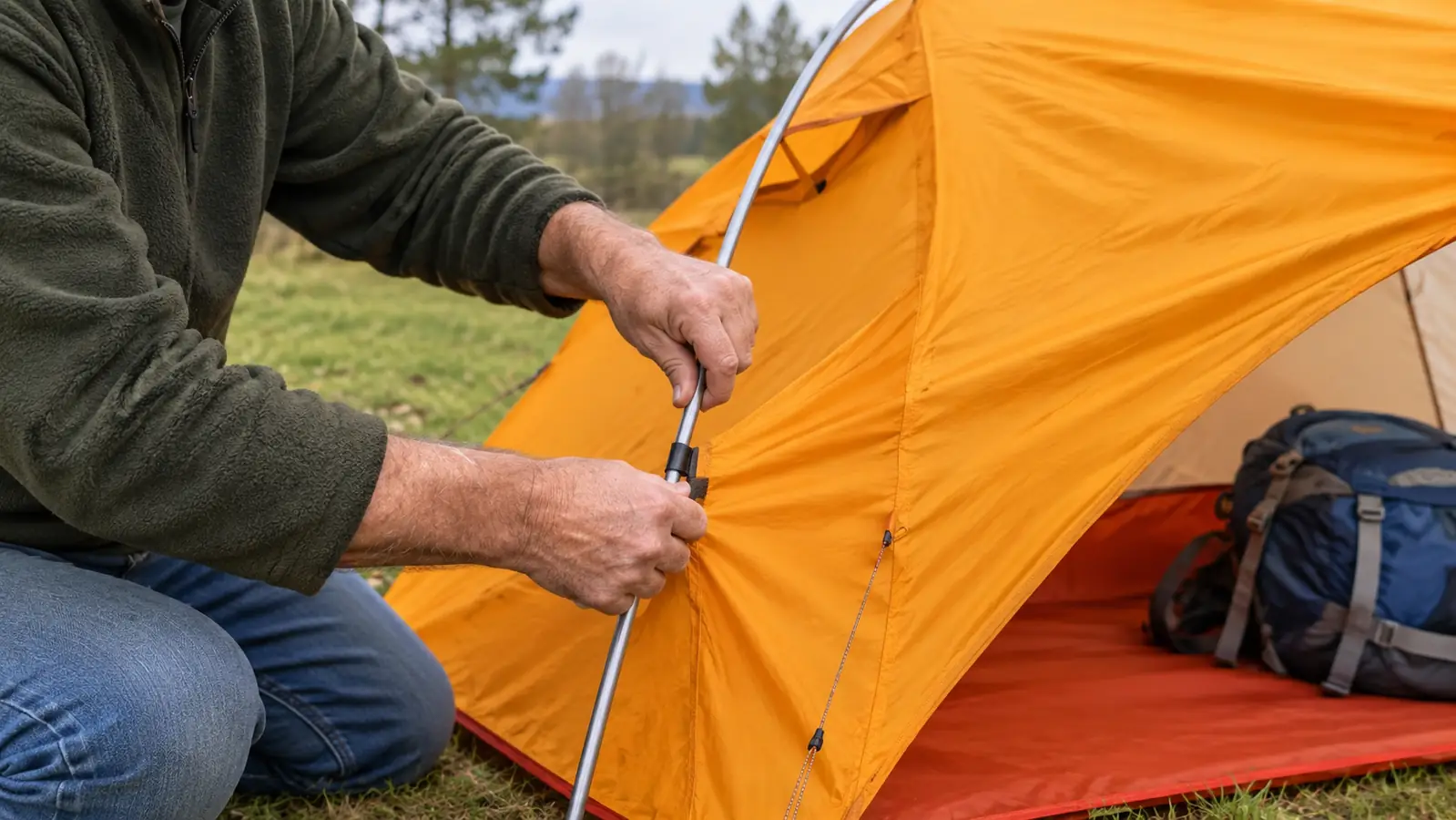
Feed each pole section so it seats fully, and check every joint with your fingers before you thread anything into the tent. A pole that is half seated will crack under load, and it will pick the worst moment of the trip to do it. Assemble the frame low, below your waist, and keep the far end pointed away from your face. In wind, a half-built pole is a javelin.
I carry a pole splint and I have used it exactly once. That was on a gusty evening when a joint had not seated properly and a section split about four inches above the ferrule. The repair took ten minutes and the tent stood all night, but the lesson was the seating check, not the splint. Run your thumbnail across every joint before the pole goes anywhere near the tent body. You will feel a gap you would never spot in failing light. And assemble the pole crouched or sitting, with the far end low and angled away from you. Standing upright with a long pole in a gust is how people lose an eye, and I am not being dramatic about that.
The Cloud-Up 2 attaches with clips. Clips are a gift in weather, because you can hold the tent body against the wind with one hand and snap clips with the other, working from the upwind end toward the door. I have owned sleeve tents and I still like them for other reasons, but on a gusty evening I want clips and I want them now.
Once the frame is in, the tent stands on its own. That is what free-standing buys you, and it is worth using. Pick the whole thing up, turn it a quarter turn if your first read on the wind was wrong, and set it down again while it is still light. Do this before the fly goes on, because after that the tent weighs more and handles worse.
Step 4: Fly on, then five wind ropes, windward first
The fly goes on next, before you admire the view or dig out a snack. Find the door first and match the fly to the body from there, working around the tent instead of dragging the fabric over it. Keep the underside of the fly off the ground. Wet pine needles and grit will find every surface you set it on.
There are five wind ropes in the bag. Five is enough if you place them well: one on each upwind corner, two at the sides, and one at the foot when the wind is doing something strange. Anchor them wide, at roughly 45 degrees from the pole, and use a stick or a rock if the ground will not hold a stake. Wide anchors spread the load. A line pulled straight out to a single point mostly just pulls the pole over.
Stake angle matters more than stake length in soft ground. Drive each stake at about 45 degrees, leaning away from the tent, so the pull of the line drives it deeper instead of lifting it out. Where the ground is too shallow for that, wrap the line around a rock and set the rock down on the line, or bury a stick sideways and pack soil over it. On one trip the foot end of my tent faced a gap between two trees and the wind came funnelling through that gap all night. I had skipped the foot line because the other four looked fine. By two in the morning the fly was snapping against the inner and I was out in the rain in my socks, adding the fifth line by headlamp. Five lines, five minutes, every time now.
Then the tension check. Run a hand along the fly. It should be taut enough not to flap and loose enough that the seams are not pulled into straight lines. In gusts, a slightly loose fly moves and survives. A drum-tight one tears, or pulls a stake and then flaps all night, which is worse than either.
Two stakes in the upwind corners before the poles come out of the bag. That is the whole trick, and it took me fifteen years of wet evenings to learn it.
Step 5: Set the tent for rain, not for looks
The Cloud-Up 2 has a ventilation window above the front door. In rain that vent is the difference between a damp night and a soaked one, because everything you breathe out has to go somewhere and it will condense on the coldest surface available. Leave it open, and set the door so the opening faces away from the weather.
Condensation is the part nobody warns you about. Two people breathing inside a closed tent at thirty-five degrees put a startling amount of water on the inside of the fly by morning, and if the fly is sealed tight it runs down the walls and onto whatever is touching them. My sleeping bag touched a wall exactly once, on a cold night in October, and the foot of it was wet through by four. The vent above the door stays open in rain unless the wind is driving straight into it. If it is, turn the tent, or work the fly so the sheltered side gets the airflow instead of shutting everything down and hoping.
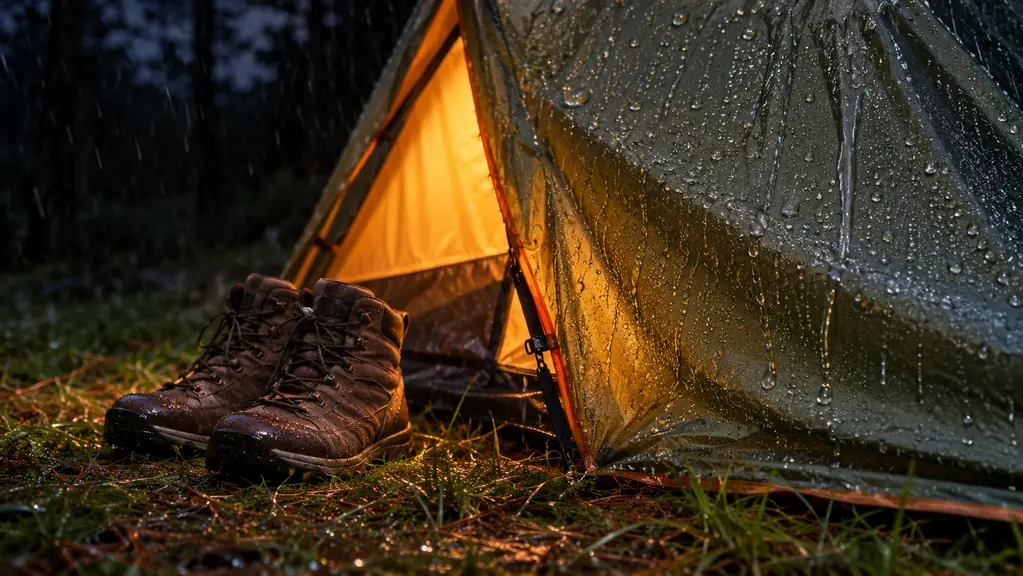
Keep the inner dry while you finish up. Fly fully on before you open the inner door. Wet rain jacket off outside if you can manage it. Packs and boots under the fly rather than inside the sleeping area. Once the inner gets wet, no amount of ventilation fixes it before morning, and you will spend the night curled around the damp spot instead of sleeping.
Do not touch the fly from the inside during rain. Every finger on the underside of the fabric draws water through, and you will not believe how much until you have done it once. The fly will sag overnight as it cools and wets. When it does, get out and tighten the windward lines rather than pushing the fabric up from below.
What Else Helps
Practice once in the yard, in daylight, before you need to do any of this in the dark. Set it up, take it down, set it up again. Nine minutes in the field is a twenty-minute fumble if you have never done it in good conditions, and a twenty-minute fumble in wind and rain is how people end up sleeping in the car.
When you break camp wet, pack the fly separately from the body. A wet fly stuffed into the same sack as a dry inner soaks everything it touches, including your spare layer. A small stuff sack for the fly solves that for almost no weight, and at home you can hang both pieces over a porch rail to dry properly instead of finding them still damp a month later.
And keep the small things where you can reach them in the dark. Headlamp on your head before the light goes, dry socks in a zip bag, stake bag in the same pocket every time. On shoulder-season trips the temperature drops fast once the sun is behind the ridge, and a wet tent at near freezing is a much longer night than the same wet tent in August.
A free-standing tent is not a tent that stays up without stakes. It is a tent you can pick up and move when your first read on the weather was wrong.
Nine minutes now, or a long wet night later
The Naturehike Cloud-Up 2 is a three-season free-standing tent for two, 4.3 pounds, packing down to 15.7 by 5.1 by 5.1 inches. Footprint and five wind ropes included, so you are not buying the small parts separately.
Amazon Check Today's Price on Amazon →