
The short answer first, because that is probably why you clicked. If you want to walk away from the car with your shelter on your back, buy the Naturehike Cloud-Up 2. If your camping is a folding chair, a cooler, and a flat spot twenty feet from the tailgate, a heavier car camping tent will make you happier, and it will not be close. I own the first kind and I have borrowed the second kind twice every summer for years, and the two of them have taught me more about gear than any spec sheet ever did.
Here is where I am coming from. I am 61, I live in Bend, Oregon, and I retired after thirty years teaching middle school science, which means I spent three decades watching people learn things the hard way and occasionally being the person learning. Dale and I car camp out of a 2014 Subaru Outback at the Cascade Lakes campgrounds from June into September, and we take two or three night trips into the Three Sisters Wilderness in spring and fall, when the overnight temperature drops close to freezing. My left knee is stiff from an old ski injury. My back has firm opinions about thin sleeping pads. That is the whole reason weight and comfort both matter to me, and the reason this comparison is not theoretical.
| Naturehike Cloud-Up 2 | Heavier car camping tent | |
|---|---|---|
| Packed weight | 4.3 pounds, with the footprint and poles in the bag | Typically 20 to 40 pounds, carried from the trunk to the site |
| Packed size | 15.7 x 5.1 x 5.1 inches, straps to the outside of a pack | A long duffel that eats most of the cargo space |
| Floor space | 82.7 x 49.2 inches, which is two pads and a pair of boots | Room for cots, duffels, and a chair |
| Peak height | 41.3 inches, so you sit up but you do not stand | Tall enough to stand and dress near the middle |
| Wind | Low 41.3 inch peak, five wind ropes, a separate fly over the inner tent | Tall walls and a big flat side for gusts to push against |
| Pitching | Free standing, clip-on poles, one person, no stakes needed to stand it up | Quick with two people, a wrestling match alone |
| A rainy day inside | You lie down, you read, you wait it out | Chairs, cards, and a dry place to cook |
| Cold nights | A separate fly over the inner tent holds a little warmth for two sleepers | Mesh panels and interior volume make it colder |
| Best for | Trips where the car stays at the trailhead | Basecamp trips where the car is the anchor |
Where the Naturehike Cloud-Up 2 Wins
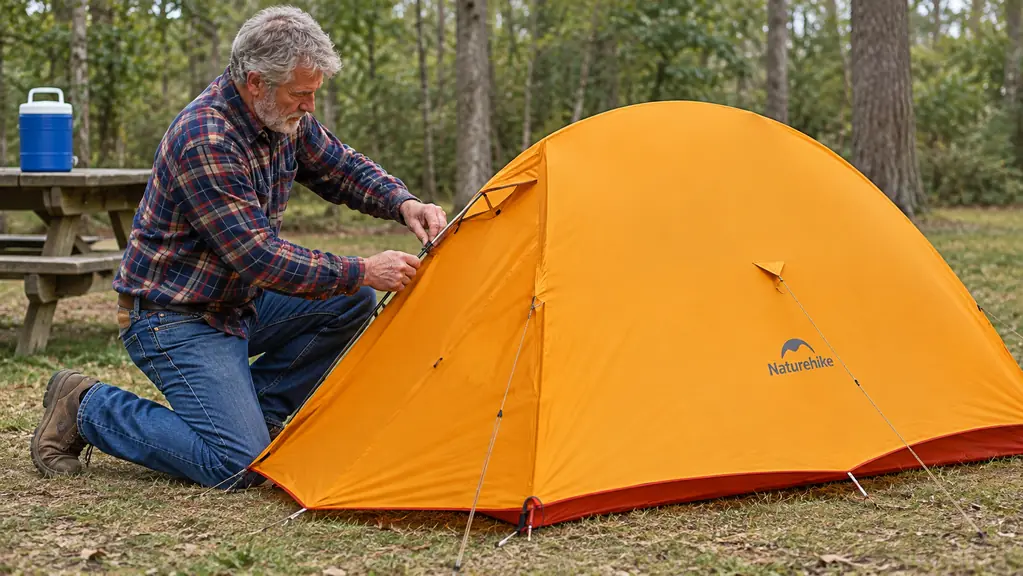
Start with the number that decides most trips. Naturehike lists the Cloud-Up 2 at 4.3 pounds, and that figure already includes the footprint, the pole set, and the five wind ropes. A footprint is not a small courtesy. It is the difference between a floor that survives a granite campsite and one that does not, and plenty of tents in this class make you buy it as an extra. The packed size is 15.7 by 5.1 by 5.1 inches, small enough to strap along the outside of a pack or drop into the bottom without shoving everything else out. I have had that bag in the Outback beside four days of food and a bear canister and still found room for camp shoes.
The first time I weighed it was on the kitchen scale in early June, before a three-night loop out of the Green Lakes trailhead. The bag came in right at the listed figure with the footprint folded inside, which is not always how these things go. I had spent the two seasons before that carrying a shelter a few pounds heavier, and the difference showed up on the climb out rather than at camp. I was still talking at the top of the switchbacks instead of stopping to pretend I wanted the view.
The second thing is weather. The shell is 210T polyester with a 3000mm+ waterproof coating, and the fly is a separate piece that goes over the inner tent rather than one wall trying to do both jobs. In the Three Sisters in late September that matters, because the rain arrives sideways around nine at night and the temperature follows it down. The peak height is 41.3 inches, low enough that the wind has less wall to push against, and the five wind ropes give you something useful to do about the gusts. There is a ventilation window above the front door as well. I did not expect to care about that and now I do. Two people sleeping in a closed tent produce an astonishing amount of moisture, and a vent is where it goes instead of onto the inside of the fly.
The night I remember is the last Friday in September two years back, when the rain started at 8:40 and the wind came through the pines behind the tent around eleven. I had the wind ropes out and a stake set at every one of them, which took maybe six minutes in the dark. The fly shed the water and the inner wall was still dry to the touch in the morning. What I did wake up to was condensation on the inside of the fly from Dale and me breathing all night, which is normal and which I now handle by leaving the vent window cracked even when it costs me a few degrees of warmth.
The third thing is that it stands up on its own. The poles clip to the frame instead of threading through sleeves, so pitching it after dark with a headlamp in your teeth takes about four minutes and very little language. Free standing also means you can pick the whole thing up and move it three feet when you find the root you pitched on top of, which I have done at least twice a season since my back started filing complaints. On a windy evening at a trailhead, that matters more than any number on the box.
Where a Heavier Car Camping Tent Wins
Now the honest part, because a comparison that gives one side every row is a sales page, not a review. The Cloud-Up 2 is 82.7 inches long and 49.2 inches wide. That is two sleeping pads and a pair of boots. The listing gives the floor area as 2.73 square feet, which is a typo for square meters, and the inch dimensions are the ones that tell the truth. My back does not tolerate a thin pad, so the pad I bring is thick, and every inch of pad is an inch off a 41.3 inch peak. In a car camping tent I sleep on a cot. I stand up to put my trousers on in the morning. I have somewhere to put a duffel that is not the same place I put my feet.
The last week of July at a Cascade Lakes site, I did the comparison by accident. I had a cot set up in a borrowed family tent with the door propped open and a book on the floor beside me, and I could stand to change out of wet shorts without kneeling on anything. Two weeks later, in the Cloud-Up 2 at 41.3 inches, I did the same job lying on my side in the dark. It is doable. It is not dignified. My knee had opinions about it the next morning on the trail, and I was slower than usual for the first mile.
The bigger difference is a rainy day. Three days of rain in a backpacking tent means three days of lying down and reading and waiting, because there is nowhere to sit and nothing to sit on. In a heavier tent with a screen door and enough floor for two camp chairs, the same three days are an inconvenience instead of the whole trip. You can cook out of the weather, hang wet jackets somewhere that is not on top of a sleeping bag, and play cards without elbowing anyone.
And the weight argument quietly reverses once the car is part of the trip. A thirty pound tent is only a problem when you lift it, and you lift it twice: out of the trunk on Friday, back in on Sunday. If the tent never leaves the site, its weight is a number on a spec sheet and nothing more. What you feel every hour instead is the height, the floor, and the standing room. That is why I keep one of each, and why I stop listening to anyone who argues that one of them is simply better.
The shelter that goes in the pack is the one that goes on the trip
The Naturehike Cloud-Up 2 comes in at 4.3 pounds with the footprint and poles included, packs to 15.7 by 5.1 by 5.1 inches, and stands up free standing in about four minutes. If your camping starts at a trailhead instead of a tailgate, this is the one to look at.
Amazon Check Today's Price on Amazon →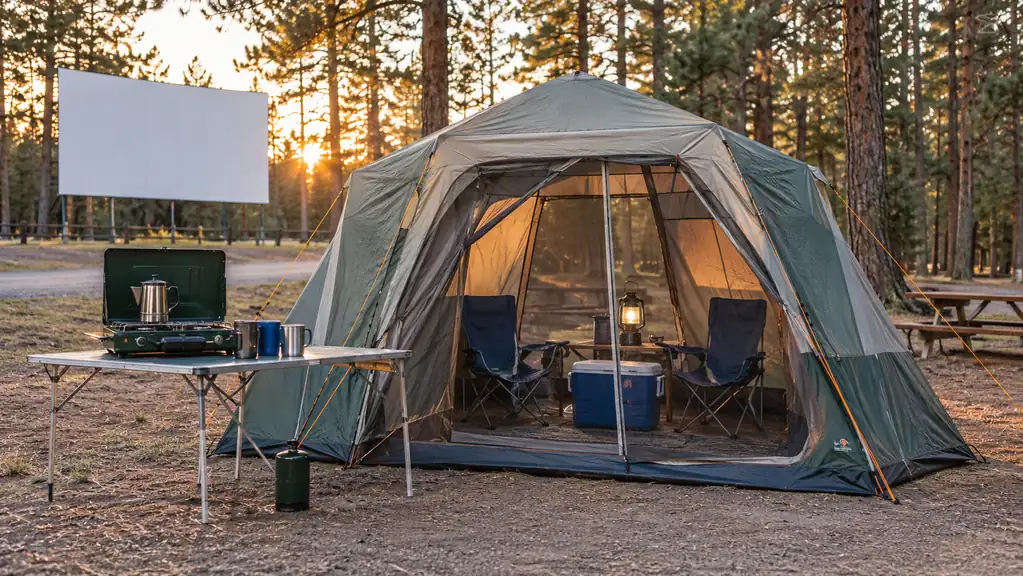
The Two-Tent Rule I Actually Follow
It took me about five years of buying the wrong thing to arrive at a rule. I own two shelters now. The Cloud-Up 2 goes on every trip where the car stays at the trailhead. A heavier car camping tent goes on the trips where the car is the point: the Cascade Lakes in July, the long weekend with the whole family at a campground with a boat ramp, the kind of trip where I want coffee at a picnic table instead of filtered out of a squeeze bag.
The mistake I made for years was trying to split the difference. I bought a mid-weight tent that was too heavy to carry comfortably and too short to stand up in, which meant it was mediocre at both jobs and I resented it every time I used it. Splitting the difference sounds sensible. In shelters it almost never is. Pick the job first, then pick the tent.
That tent was 12 pounds, 78 inches long, and 44 inches at the peak, so it was too heavy for a two-night carry and too short to stand in at a car site. I took it on four trips and complained on all four. The low point was a wet August weekend when I carried it a mile and a half to a lake and then spent the evening folded up like a pocketknife because the walls sloped in at my shoulders. I sold it the following spring and did not miss it once.
There is a second reason the rule works for me at 61. Pack weight is not the only cost of a shelter. Getting up off the ground at two in the morning is a cost, especially with a knee that does not bend first thing. Bending to clip a pole when everything is stiff is a cost. The Cloud-Up 2 pays for the walking part. The car tent pays for the sleeping part. You are always buying one of those discomforts, you are just choosing which.
The other thing I appreciate about the Naturehike tent is that it does not make a production out of anything. On a busy weekend at a forest service campground, a small tent pitched quietly on a pad draws no attention, and it comes down in a few minutes in the rain because there is nothing complicated to undo. That will not show up in the listing bullets. It is the reason I keep choosing it.
Splitting the difference between a backpacking tent and a car camping tent is how you end up with one shelter that is mediocre at both jobs.
Who Should Buy Which
Buy the Naturehike Cloud-Up 2 if you walk away from the car with your shelter, if most of your trips are two or three nights, if you sleep with one other person and can live out of a pack instead of a duffel, and if you are willing to put a decent pad under yourself. It carries a 4.5 star average across roughly 2,400 ratings, which is the sort of score that usually means the tent does exactly what the listing says and nothing more dramatic than that. It is a free standing three season tent with a 3000mm+ coating and a footprint in the bag. That is the whole promise.
Buy the heavier car camping tent if the car is your basecamp, if you want to stand up and dress, if a rainy afternoon needs chairs and a table and a place to hang four wet jackets, or if you sleep on a cot because your back has decided it is finished with the ground. You are not giving up much except trunk space and the ability to carry the shelter anywhere, and if you never carry it, that is not a real loss.
Where the Cloud-Up 2 falls short, plainly: two adults plus two packs is a tight fit, and you cannot sit up comfortably at the same time a thick pad is under you. Cold, humid nights with two people breathing in a closed tent put condensation on the inner wall unless you leave the vent open and accept a cooler tent in exchange. And over a long season the floor takes a beating, which is exactly why the included footprint is worth more than it looks on the spec sheet.
If the next trip starts at a trailhead, you already know which one you need
Naturehike lists the Cloud-Up 2 at 4.3 pounds with the footprint, poles, and five wind ropes included, 82.7 by 49.2 inches of floor, and a separate fly over the inner tent. It is the shelter I reach for when the car stays parked.
Amazon See the Cloud-Up 2 on Amazon →