
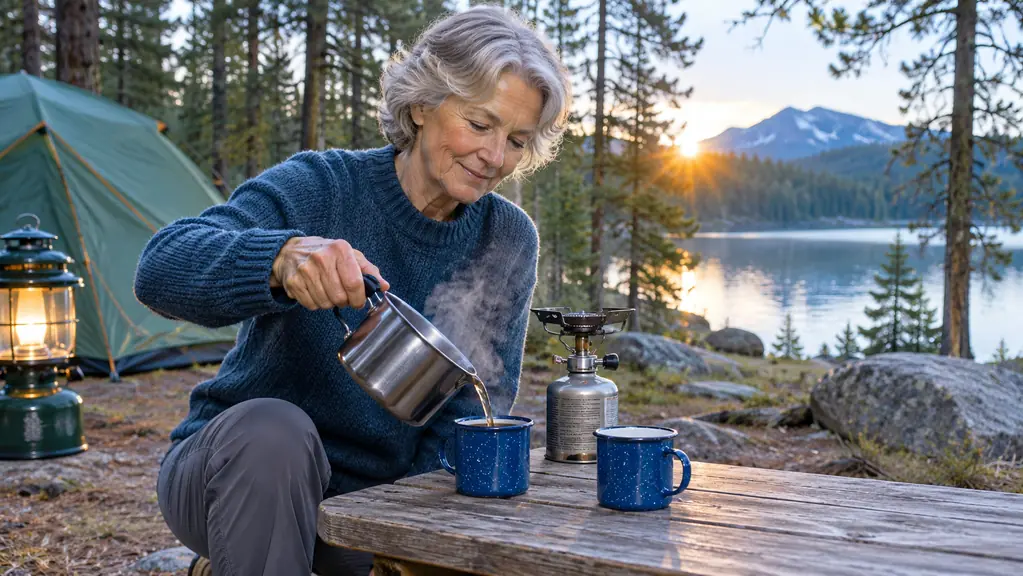
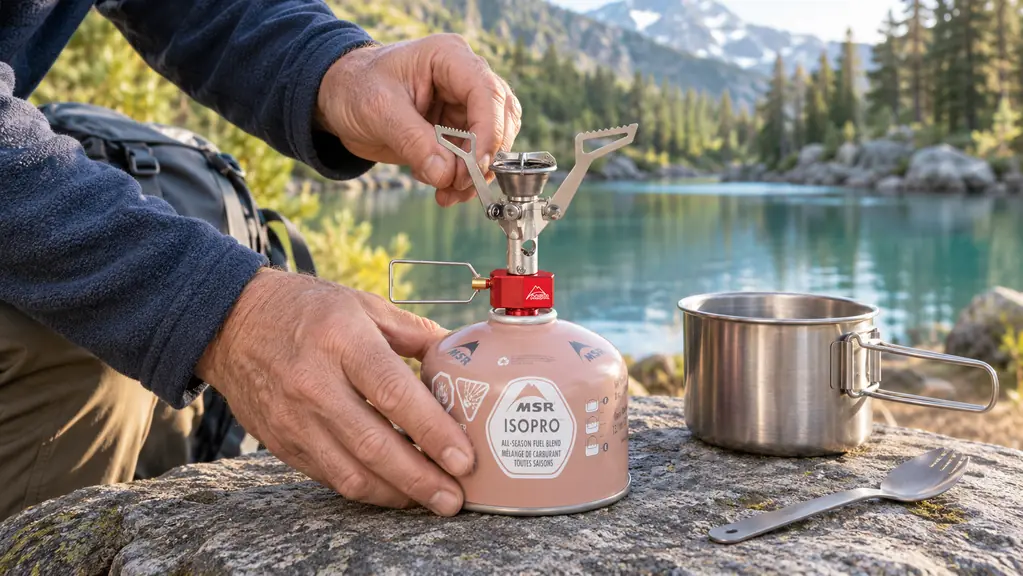
The short answer first, because I know why you are here. If you count ounces and already carry a lighter in your pocket, the MSR PocketRocket 2 is the stove I would put in your hand. It weighs 2.56 ounces, folds to roughly 2 by 2 by 3 inches, and has boiled a liter of water for my coffee on every trip I have taken it on. Mine lives in the top pocket of my pack and I forget it is there, which is exactly what I want from a stove at 61 with a knee that files complaints.
The Jetboil MightyMo makes a different argument, and it is a fair one. It has a push-button igniter built into the burner, so you are not on your knees in the frost hunting for a match while your hands go numb. If you have ever stood over a cold burner at dawn with stiff fingers and damp wood everywhere, that button is worth more than it sounds. The MSR asks you to bring fire. The MightyMo brings its own.
| MSR PocketRocket 2 | Jetboil MightyMo | |
|---|---|---|
| Weight, stove only | 2.56 ounces | Around three and a half ounces |
| Folded size | About 2 by 2 by 3 inches, disappears in a side pocket | Folds small as well, sits a little taller in the pack |
| Igniter | None, so pack a lighter or matches | Push-button igniter on the burner |
| Pot support | Three folding arms, steady with pots up to about a liter | Wider arms that hold a bigger two-person pot with less wobble |
| Flame range | Simmers down to a low flame, easy to dial back for rice | Also simmers, similar usable range |
| Fuel | Threaded isobutane canisters, self-sealing | Threaded isobutane canisters, self-sealing |
| Best for | Backpackers counting ounces who already carry a lighter | Campers who want ignition built into the stove |
Where the MSR PocketRocket 2 Wins
Weight is the obvious one, and I do not want to wave it away. Two and a half ounces against three and a half is a single ounce, and a single ounce sounds like nothing until it is the eighth single ounce you have talked yourself into. On a three-night trip into the Three Sisters I am already carrying a shelter, a quilt rated for frost, a thin pad my back tolerates under protest, and food. The MSR is the one item that never asks for a vote. It goes in the pocket, it comes out when the water needs to boil, it goes back in.
A couple of seasons ago I started weighing my loaded pack on the kitchen scale in March, before the first trip, because I had convinced myself I was being careful and I wanted the number to prove it. It did not. The pack came in at 31 pounds for a three-night trip, which is more than my back wants to hear about. What that exercise taught me is where weight actually hides: in the small stuff, the extra mug, the second lighter, the camp shoes I never wear. The stove is one of the few places where the lighter option is genuinely lighter and also genuinely fine. There is no comfort penalty for carrying 2.56 ounces instead of three and a half. You do not sleep colder or eat worse. You just carry less, and the climb out of Green Lakes in September is where you notice it, when the trail tilts up and your knee has already registered its opinion.
The second thing it wins on is simplicity, which I have come to value more as I get older. There is no igniter to fail, because there is no igniter. I had a piezo starter die on another stove years ago on a wet night near Mount Bachelor, and I have carried a small lighter ever since regardless of what stove I own. That makes the MSR's missing button a non-issue for me. Fewer parts, fewer things that quit in the cold, and a three-year limited manufacturer warranty against defects in materials and workmanship if the one part that matters does go.
Then there is the cooking, which is where cheap stoves usually fall apart. The PocketRocket 2 claims a liter boiled in about three and a half minutes, and in still air at 6,000 feet I would say that is honest. More useful to me is that the flame turns down. I can hold a low flame under a pot of rice and walk away to find my mug, and it does not scorch. Dale and I have done actual food on it, not just freeze-dried bags: rehydrated black beans, a pot of instant polenta, pancakes at a car camp on the Deschutes where the coffee mattered more than the pancakes. It comes with a hard shell carry case, which sounds like a small thing until the stove has ridden against a fuel canister for a season.
Where the Jetboil MightyMo Wins
The igniter is the honest headline. One push, one click, one flame, no digging in a hip-belt pocket with gloves on. On a morning when it is 29 degrees and everything metal wants to stick to your skin, that is not a luxury, it is the difference between a hot drink and a cold start. I have friends in their seventies who still backpack, and every one of them has told me the same thing: the small motor tasks are what get taken away first. A button beats a flint when your hands are cold and your grip is not what it was.
There is a specific morning I keep coming back to. Late September, Sparks Lake, frost thick enough on the picnic table that I could write my name in it, and my hands already stiff from breaking camp. A friend had the MightyMo. She pushed the button once and had flame. I was on my knees with a lighter, cupping both hands around the burner, and it took me three tries, because the cold had gotten into the valve and my thumb was not cooperating. Nothing dramatic happened. Nobody was hurt and the coffee got made. But I stood there thinking that the extra ounce she was carrying had bought her about four minutes and a better mood, and four minutes at 29 degrees is worth something. That is the whole argument for the igniter, and I do not think it can be made more plainly than that morning made it.
The pot support is the second win, and it is the one people underrate. The MightyMo's arms spread wider, so a bigger pot sits on it without that teetering feeling you get when a two-person pot is balanced on three small tabs. If you cook for two, or you car camp and haul out the heavier cookware because there is a car to carry it, that wider footprint means you are not holding the handle steady with one hand while stirring with the other. My left knee does not enjoy crouching to catch a tipping pot.
And the MightyMo feels a little more planted overall, a sturdier stance on uneven ground. That extra ounce is doing something. It is not magic, and it will not turn a windy exposed ridge into a kitchen, but on a granite slab at a lake with a bit of a breeze it sits there and does its job. When the wind really gets up I still hunch my shoulders around the stove like a brooding hen, same as I do with the MSR. No small canister stove wins that fight on its own.
A stove that weighs 2.56 ounces is a stove my knee never notices on the climb out, and at this point in my life that is the review that matters.
If you already carry a lighter, this is the stove that disappears in your pack
The MSR PocketRocket 2 boils a liter in about three and a half minutes, simmers low enough for real food, and folds into a pocket at 2.56 ounces. It is the one I carry when the pack weight is my problem and not the stove's.
Amazon Check Today's Price on Amazon →
Who Should Buy Which
Buy the MSR PocketRocket 2 if you are backpacking and every ounce is a negotiation, if you already carry a lighter out of habit, and if you want a stove with no moving parts that can quit. It suits the two- or three-night trip where you are boiling water for one or two people and eating mostly out of a bag with a few real meals thrown in. It also suits anyone who has been burned by an electronic starter before and does not trust them. The self-sealing threaded canisters mean you can unscrew a half-used fuel canister and put it back in the pack without leaking, which matters when you are breaking camp in a hurry.
Buy the Jetboil MightyMo if the morning ritual is the part you dread, if your hands are not as strong or as warm as they used to be, or if you routinely cook for two in a bigger pot. It is a better car-camping stove for the same reason it is a good base-camp stove: nobody is counting grams when the Subaru is twenty feet away, and the button and the wider arms both earn their keep. If you make coffee before you make anything else, and you make it before the sun is properly up, the igniter will pay you back every single morning of the season.
The pot question is worth settling before you buy, because it is more concrete than any spec sheet. When Dale and I cook together we use a pot close to a liter and a half, and the MightyMo holds it without the balancing act. On the MSR we drop down to the smaller pot, nearer a liter, and it is perfectly steady as long as I set it down squarely and do not bang it with a spoon while stirring. If your usual pot is bigger than a liter, that alone is a reason to pick the MightyMo, and it has nothing to do with the igniter. Put a tape measure across the bottom of your pot before you decide. The answer is in the diameter.
If you genuinely cannot decide, ask yourself one question. On your worst morning, the one where it is below freezing and you slept badly, would you rather save an ounce or save a match? There is no wrong answer. It just tells you which stove you are.
What I Would Tell a Friend in the Gear Aisle
Neither of these is a simmering, sauteing camp kitchen. They are boilers that happen to be controllable, and that is what most of us actually need. If you want to cook elaborate meals at a campground, you want a two-burner propane stove and a folding table, not a canister stove you have to babysit. I say this because people buy a tiny stove, try to make a four-part dinner on it, get frustrated, and conclude the stove is bad. The stove is fine. The expectation was wrong.
I keep a folded piece of aluminum flashing in my cook kit as a windscreen, and it has done more for my boil times than any stove upgrade I have ever made. I cut it from a roll that had been sitting in the garage for years, it weighs a couple of ounces, and it turns a stubborn flame on a breezy granite slab into a proper burner. Foil works in a pinch but it shreds by the second trip. The flashing has lasted me seasons. I also carry a small disposable lighter and a second one in the repair kit, because I have been the person with no fire at dawn and I do not care to be that person again.
The last thing I would say is to test-fire whichever stove you buy in your own driveway, in daylight, before you are depending on it in the dark. Fill a pot, boil it, turn the flame down and see how low it will actually go without going out, then let it cool and screw the canister off and back on. If something is going to be wrong with the threads or the valve, you want to find out with the sun still up and a real dinner still possible. I have watched more trips go sideways over a stove nobody had tried than over any piece of gear failing on its own. Whichever one you choose, learn its habits in the daylight, and at 6 a.m. in the cold it is just a familiar tool and not a puzzle.
See the full field notes before you commit
Six trips, one stiff knee, and a running list of what the MSR PocketRocket 2 does well and where it still asks you to compromise. Read the long-term review first, then decide.
Amazon Check Today's Price on Amazon →