
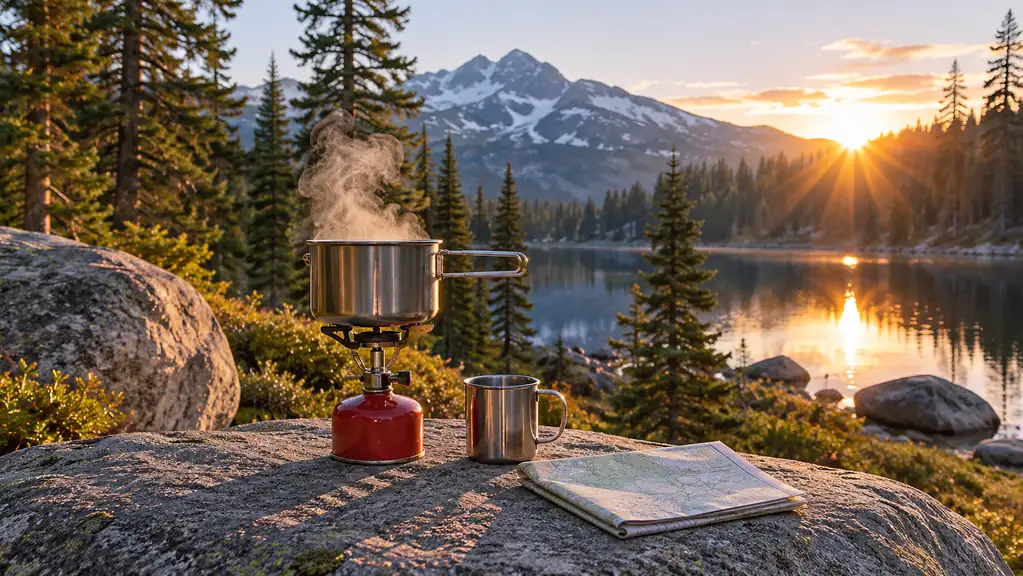
My first backpacking stove weighed more than my tent. I carried it for three seasons anyway, because I did not know any better, and because hot coffee at six in the morning in a cold camp is worth almost any amount of weight. Then a friend set an MSR PocketRocket 2 on a picnic table at a Cascade Lakes campground, handed me a liter of water, and told me to time it. That was several years ago. The heavy stove has been in a box in the garage ever since.
I am 61, retired from teaching middle school science, and I live in Bend, Oregon, where the shoulder seasons get cold enough that a stove stops being a luxury. My husband Dale and I car camp out of a 2014 Subaru Outback most summer weekends and take two or three night trips into the Three Sisters Wilderness once the snow clears. My left knee is stiff from an old ski injury and my back has firm opinions about thin sleeping pads, so weight matters to me now in a way it did not at 30. This is what the PocketRocket 2 has actually done on those trips, including the parts that irritate me.
The Quick Verdict
Boils a liter fast, weighs almost nothing, and simmers better than a stove this small has any right to. Fussy in wind and tippy with a wide pot, and I still pack it every single trip.
Amazon Check Today's Price →The stove that lives in my pack from May to October
2.56 ounces, folds down to the size of a fist, screws onto a standard threaded canister. Four seasons of mornings on it and it still lights on the first try.
Amazon Check Today's Price on Amazon →How I've Used It
The PocketRocket 2 has been in my pack for four seasons, which works out to something near sixty nights out. It has boiled water for oatmeal at a foggy campground west of Bend, rehydrated a long line of uninspired dehydrated dinners at a site above Green Lakes, and made coffee for two every morning of a three night loop near Broken Top. It folds down small enough that I stopped noticing it in the top pocket of my pack, sitting next to the fuel canister it screws onto.
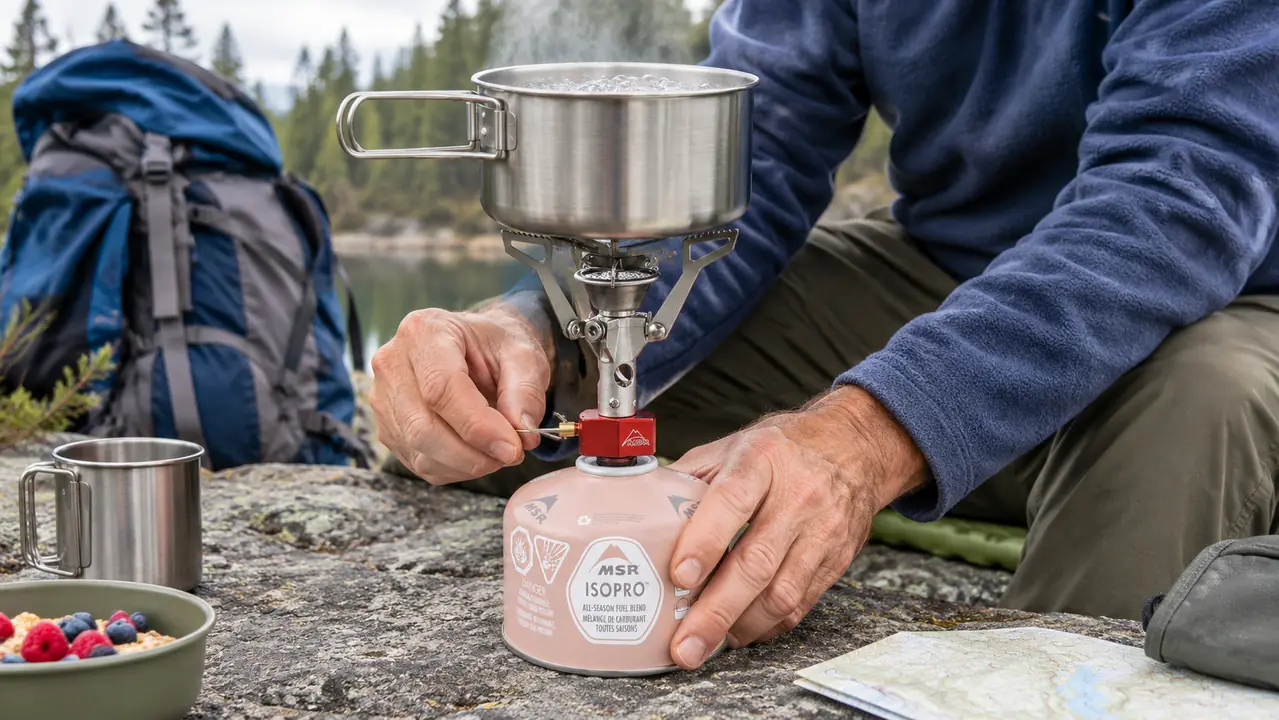
Setup takes about as long as it takes to read this paragraph. Screw the stove onto a self-sealing threaded isobutane canister, fold it open, turn the valve, light it. No priming, no pumping, no ritual. On a cold morning my hands are not at their best and I can still manage it without my reading glasses, which is a test I apply to more gear than you would think.
Dale is the one who times things. He has a stopwatch app he enjoys far too much. Our real world routine, with water dipped straight from a lake, runs closer to four or five minutes than the three and a half minutes the listing claims, and I think that is fair. Cold water, a breeze, a bit of altitude. When we fill from a tap at a campground and the morning is mild, it hits the number almost exactly.
One morning I remember clearly: the second week of September two years back, a site at Green Lakes, frost on the bear can and my water bottle half frozen where I had left it out. I had the pot on and coffee poured in under six minutes, and that included the time I spent patting down my jacket for the lighter in the dark. Dale's stopwatch read five minutes forty. That is not a laboratory number. It is the number that decides whether I am warm and pleasant or cold and quiet for the first hour of hiking, and I will take it.
What 2.56 Ounces Buys You
The stove itself weighs 2.56 ounces on my kitchen scale, which matches what MSR prints on the box. Add the hard shell carry case and you are still under four. Folded up it measures 1.7 by 1.3 by 3.1 inches, and I checked that with a ruler because I am that person. It drops into my titanium mug with room left for a lighter and a folded bandana.
For scale, that is roughly the weight of two AA batteries and a shade less than my reading glasses in their case. I put the whole kit on the scale once out of curiosity, stove, case, lighter, and a small canister together, and it came in around nine ounces. The old stove was nearly a pound before I attached any fuel to it. My kitchen for a three night trip now weighs less than my rain jacket, and that arithmetic is the reason the PocketRocket 2 has never gone back in the garage box.
What that weight really buys is not a lighter pack. It buys the willingness to bring the stove at all. There is a stretch of the Pacific Crest south of us where I used to leave the heavy stove behind to save pounds, and I ate cold suppers for two days and was miserable about it. Now the stove comes along on every trip, including the ones where I am fooling myself about how far I will hike.
The aluminum body has taken a beating and looks it. It has been dropped on granite, banged around in a stuff sack for four years, and once tipped over with a full pot of near boiling water on it, which is a story about my own carelessness and not about the stove. The valve still turns smoothly and the burner still puts out a steady flame. Nothing has loosened.
Three and a half minutes on a mild morning, five in the wind at 7,000 feet. Either way the coffee is poured before Dale finishes fussing with the bear can.
Boil Times, Simmer Control, and Cold Mornings
The claim that interested me most was the simmer. Most tiny canister stoves I have owned have two settings, off and roaring, which is why so many backpackers give up and eat out of a pouch. The valve on this one moves gradually, and I can hold a low flame under a small saucepan of rice and lentils without scorching the bottom. I have done it more than once. It takes attention, because a stove this small is not a kitchen range, but it means a real cooked meal on the second night instead of another bag of sadness.
The first time I tried actual cooking on it, I scorched a pot of red lentils, and the fault was entirely mine. I had the valve open too far because I did not trust a flame that small to keep the pot going, so it boiled hard and stuck, and I spent ten minutes soaking the saucepan in the lake. The second attempt I turned it down until the flame was barely visible in daylight, stirred more often than I wanted to, and the lentils came out fine. Now I know roughly where the sweet spot sits on the valve and I can find it by feel, even in low light.
Cold is the honest limitation. Below about 40 degrees the canister gets sulky, and that is true of every isobutane stove I have used rather than a knock on this one. My routine in the shoulder seasons is to keep the canister in the foot of my sleeping bag overnight and accept that the first pot of the morning takes an extra minute or two. A friend of mine insists on a chemical hand warmer beside his. I have not gone that far.
Fuel use has been reasonable. A small canister gets me through three or four days of morning coffee and evening boiling in mild weather, less if it is cold and I am impatient. I write the date on each canister with a paint pen so I know which one to take on a longer trip, which is the least glamorous piece of camp advice I can offer and one of the more useful.
Where the PocketRocket 2 Fights Back
There is no wind protection at all. Not a whisper of it. On an exposed granite bench with a breeze coming off a lake, I have built a low wall of rocks and hunched over the stove like a broody hen, and the flame still wandered. On genuinely windy evenings I move to the lee side of a boulder or cook inside the vestibule, and I say that as someone who is careful about it. A foil windscreen would help, and I keep meaning to make one and keep forgetting.
One evening near Broken Top the wind came up fast while the water was still cold, and I stacked a rock wall on three sides, which helped only a little. I tried folding a piece of heavy foil behind the burner and it flapped, got hot, and I gave up on it inside a minute. What finally worked was moving the whole operation behind a boulder twenty feet away and sitting flat on the ground with my back to the gusts. It cost me a few minutes and some dignity. If I cooked in exposed country every week I would buy a stove with a windscreen built in.
Stability is the other tradeoff. The stove sits low, which helps, but the base is small and the whole thing wants level ground. A one liter pot is comfortable. Anything much wider than that, on anything less than flat ground, and I am holding the handle while it heats. I do not walk away from it, and I would not set it on a sloped picnic table and turn my back.
You also need a lighter or matches, every time. Mine lives in the mug with the stove so there is never a morning where I am patting down every pocket while Dale makes helpful suggestions. That is not a defect, it is just how the stove works, and the habit costs nothing to build.
Care, Fuel, and the Small Annoyances
Fuel is not included, so buy a canister before your first trip rather than at the trailhead. The stove takes self-sealing threaded isobutane propane canisters, the ones you see everywhere, and I have never had trouble finding one at an outfitter in Bend or a ranger station store. The one time I nearly got caught short was a Sunday afternoon in a small town with everything closed, which is my fault and not MSR's.
The included hard shell case is genuinely useful, which is not always true of cases. It keeps soot off the inside of my mug and keeps the stove from rattling against everything else in the pack. Mine has a hairline crack along one edge after four years and still does its job. If it ever gives out I will happily carry the stove bare and wipe the pot more often.
MSR covers it with a three year limited manufacturer warranty against defects in materials and workmanship. I have never needed to use it, and I like knowing it is there. What I would tell you from my own bench of failures is that this stove has not given me a reason to call anyone.
The Comparison I Keep Making
If you are weighing this against an integrated system like the Jetboil Mightymo, the honest tradeoff is speed and wind protection against weight and packability. The integrated systems boil faster in a breeze and you never fight with a pot. They also weigh more and take up a whole corner of your pack. I have watched Dale drink his coffee a full two minutes before me on a windy morning, and I have watched him repack a larger bundle afterward while I tucked my whole kitchen into a mug.
Against a bigger two burner car camping stove, there is no contest on cooking capacity and no contest on weight. For the Outback weekends, where we are eating out of a cooler and something is simmering for an hour, the big stove comes along and the PocketRocket 2 stays in the bin as a backup. For anything that goes on my back, the big stove does not get a vote.
What I Liked
- 2.56 ounces on my scale, and it disappears into a mug
- Simmers low enough for rice and lentils, not just boiling water
- Screws onto standard self-sealing threaded isobutane canisters
- Boils a liter in about 3.5 minutes on a mild, still morning
- Hard shell case included and actually worth carrying
- Three year limited warranty and nothing in four seasons has needed it
Where It Falls Short
- No wind protection whatsoever, and a breeze will find the flame
- Small base wants level ground and a pot no wider than about a liter
- Fuel canisters sold separately
- Cold canisters need warming before they perform well
- You have to bring your own lighter, every trip
Who This Is For
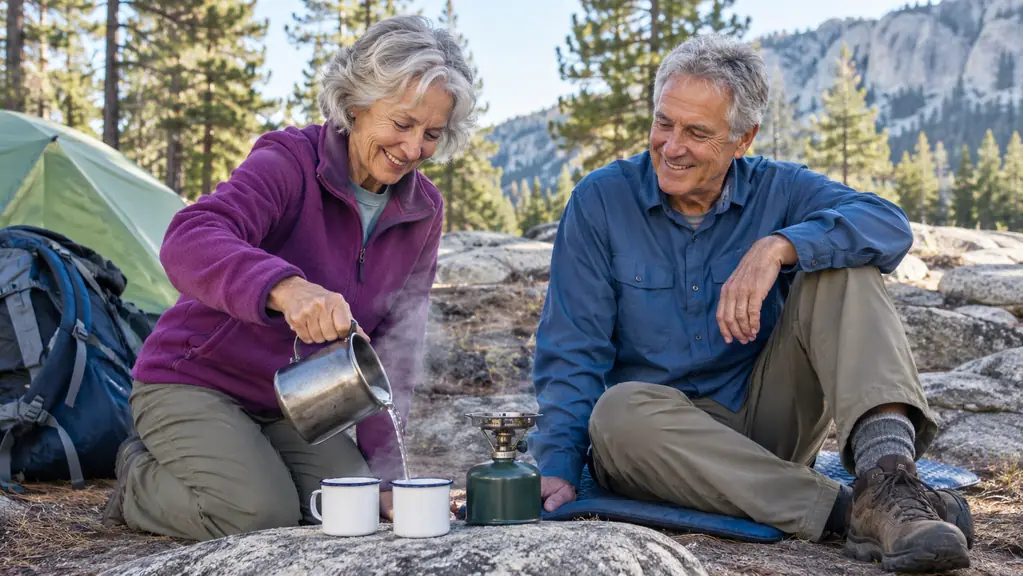
This stove suits the backpacker who wants boiling water done quickly and a real simmer when the evening calls for it, and who is willing to spend two minutes finding a sheltered spot to cook. It suits the car camper with limited trunk space, the person who has started leaving the heavy kitchen at home, and anyone whose knees have begun to file complaints about pack weight. It suits a couple sharing one small pot of coffee at a cold campsite, which is most of what Dale and I use it for.
Who Should Skip It
Skip it if you cook in exposed, windy places and want to stop thinking about the weather. Skip it if you regularly feed three or four people and need a wide pot and a stable base. Skip it if your trips involve an hour of simmering, or if you want one integrated unit that does everything without you holding the handle. Those are all good reasons to buy something heavier, and I would rather tell you that than sell you the wrong stove. What I would say is that if your trips look like mine, an early morning at a Cascade Lakes campground and a stiff climb to a small lake in the Three Sisters, the PocketRocket 2 will earn its two and a half ounces over and over.
The stove I keep re-packing every spring
Four seasons, sixty nights, no failures. If you want boiling water and a real simmer without losing pack space, this is the one I keep reaching for.
Amazon Check Today's Price on Amazon →